This website uses cookies to store information on your computer. Some of these cookies are used for visitor analysis, others are essential to making our site function properly and improve the user experience. By using this site, you consent to the placement of these cookies. Click Accept to consent and dismiss this message or Deny to leave this website. Read our Privacy Statement for more.
Print Page   |   Contact Us   |   Sign In   |   Join EPS
News
Group HomeGroup Home Blog Home Group Blogs

Report of the Second ANP 2024 (Thessaloniki, 23-27/09/2024)

Posted By Administration, Monday 9 December 2024

Innovative applications of nuclear physics in the fields of energy, medicine, materials science, security through sensing technologies, space, environment, heritage conservation are showcased at the international conference on Applied Nuclear Physics (ANP2024), held at the Center Dissemination of Research Results of the Aristotle University of Thessaloniki (AUTh), Greece, between 23-27 September 2024.

ANP2024 was the 2nd edition of the International Conference Series, after the first one hosted in Prague in 2021, with the support of the European Physics Society (EPS). The main aim is to highlight the importance and disseminate the research results in the field of applied nuclear physics to the international scientific community. ANP2024 was supported by the Greek Atomic Energy Commission (GAEC) and was under the auspices of the Hellenic Nuclear Physics Society (HNPS), a non-profit scientific association, founded in 1990 and acts as the official body of nuclear scientists in Greece.

As the AUTh Rector, Professor Charalambos Feidas, stated during his opening of the ANP2024 conference: "The applications of nuclear physics offer societies sustainable solutions in energy, innovative medical treatments, space missions, the preservation of our cultural heritage. The field offers transformative solutions to some of the biggest challenges we face", while he added: "At conferences like this we can exchange ideas and forge partnerships, shaping a better future for our world," also noting that hosting ANP2024 at AUTh highlights the important role of the university and the physics department's research team in the advancement of Applied Nuclear Physics.

The importance of Applied Nuclear Physics in scientific research and technological development was underlined by the conference Chair and the Head of the School of Physics at Aristotle University of Thessaloniki, Professor Alexandra Ioannidou, focusing on the cooperation of the scientific community with the institutional bodies to ensure the safe and innovative use of nuclear energy and technology, In this context, she explained that the conference will provide networking opportunities and the development of new partnerships. "The contacts made here are just as important as the knowledge we share, often leading to long-term relationships and partnerships", she noted.

The goal of the conference is to strengthen the connection of the European Union of Physicists with the respective national partners”, pointed out the Chair of the Nuclear Physics Division of the European Physical Society (EPS), Professor Alessandra Fantoni (INFN Frascati, Italy) noting also that the EPS applied physics awards will to be awarded, in a special session, to the scientists Professor Alberto del Guerra (University of Pisa and INFN, Italy) and Professor Laura Harkness-Brennan (University of Liverpool, United Kingdom).

ANP2024 has been a successful EPS conference paving the path for the next one in the series. A Special Issue in the peer-reviewed journal "Applied Radiation and Isotopes" is dedicated to a limited number of original research papers presented, while all other contributions will be hosted in a Special Volume of the peer-reviewed HNPS Advances in Nuclear Physics" Proceedings Series.

ANP2024 had more than 150+ attendees, almost equally distributed between young and senior researchers. See some statistics in the Figures below. 

Besides its 5 days of talks, its 6 Plenary sessions, its 24 parallel sessions, and a Poster session with 3 awards sponsored by the Arizona Carbon Foil Co. and the EPS, ANP2024 gave the participants to enjoy the social program and swim in the blue waters of the Aegean Sea.

ANP2024 website: https://hnps.eu/ANP2024


Figure 1 - ANP2024 Participants per career level

Figure 2 - Participants per country of origin

Figure 3 - Participants per gender

Figure 4 - The AUTh Rector, Prof. Ch. Feidas and the AUTh Dept. of Physics Chair, Prof. A. Ioannidou

Figure 5 - The Chair of the EPS Nuclear Physics Division, Prof. Alessandra Fantoni (INFN Frascati, Italy)

Figure 6 - The recipients of the 2024 EPS Applied Nuclear Physics Prize, Prof. Alberto Del Guerra (University of Pisa and INFN, Italy) and Prof. Laura Harkness Brennan (University of Liverpool, United Kingdom)

Figure 7 - Robert Stoner (ACF Co.) and Alessandra Fantoni (EPS) deliver the prizes for best posters


Tags:  ANP  conferences  EPS NPD 

Permalink
 

Report of the NPA-XI 2024 (Dresden, 16-20/09/2024)

Posted By Alessandra Fantoni, Saturday 26 October 2024

The 11th edition of the Nuclear Physics in Astrophysics conference series, in brief NPA-XI, concluded successfully in Dresden, Germany.

There was a record number of 191 academic participants (126 PhD scientists, 53 graduate students, and 12 undergraduates from the local university). Participants came from 18 EU+ countries and 10 countries in the Americas, Asia, and Africa. More than a third of the participants were from Germany, and there were six or more scientists each from Italy, the United States, the United Kingdom, France, Hungary, Belgium, and Poland.

The gender makeup was in line with the statistics of the field overall, with 28% female participants and 36% of the invited talks given by women.

In altogether 33 invited and 48 contributed talks, all of them in the plenum, and 80 poster contributions, participants summarised the state of the art in nuclear astrophysics and related fields. Both the contributions overall and the individual sessions were balanced between experiment, theory, and observation. Most poster presenters used the opportunity to present their work in a one-minute poster pitch in the plenum. Due to the generosity of the European Physical Journal A and the NuPECC committee, altogether four poster prizes with 200-400€ financial award each were selected amongst the many excellent posters.

Topics discussed included the observed and predicted elemental compositions of the earliest stars, neutron capture nucleosynthesis including its outputs and scenarios, the observation and interpretation of multi-messenger events, a proposed new nucleosynthesis process, gravitational waves, and advanced laboratory experiments. The high share of young participants (in addition to 53 PhD students, there were 14 postdocs with less than two years after the PhD and even 12 undergraduates - altogether 41%) is encouraging given the fact that there is still much to study and learn regarding the synthesis of the chemical elements in the cosmos.


The conference was co-organised by the Dresden-based institutions HZDR, TU Dresden, and DZA Deutsches Zentrum für Astrophysik, in close partnership with regional partners from the University of Wroclaw, the AIP Leibniz Center for Astrophysics Potsdam, and the Museum für Naturkunde Berlin. Two of the founding fathers of nuclear astrophysics agreed to contribute: Professor Friedel Thielemann from the University of Basel gave a public outreach talk in German for the general public. Professor Roland Diehl from MPE Garching summarised the state and outlook of the field in a dinner speech, given not as originally planned aboard a steamboat on the river but due to flooding simply in a restaurant. Four company exhibitors from fields as diverse as instrumentation, publishing, and accelerator construction contributed to the innovation aspect of NPA-XI.


Daniel Bemmerer 


Tags:  conferences  NPA  Nuclear Physics in Astrophysics Conference  TU Dresden 

PermalinkComments (0)
 

Call for 1 NPS elected member

Posted By Alessandra Fantoni, Monday 12 August 2024
Nomination is open for 2 (two) new ordinary board members of the EPS Nuclear Physics Division (EPS-NPD).  


Nomination is open for 1 (one) new ordinary board member of the EPS Nuclear Physics Division (EPS-NPD).  


The members of the Board are expected to attend Board meetings, which take place twice a year.
Please note that the newly elected board member will be invited at the fall board meeting in Paris already scheduled for October 28th-29th 2024. 

Some of the activities of the NPD are the following:

- Organisation of the European Nuclear Physics Conference series,
- Organisation of the Nuclear Physics in Astrophysics Conference series,
- Organization of the Applied Nuclear Physics Conference series,
- Awarding three prestigious prizes: Lise Meitner Prize, Applied Nuclear Physics Prize (ex IBA Prize) and PhD Thesis Prize.  


The board produces publications on various nuclear physics related topics, for example so called EPS Position Papers and provides input to the EPS on issues related to nuclear physics and relations to other European and international bodies interested in nuclear physics and policy.  


For more information, you may visit the NPD website.
http://www.eps.org/?page=npd  


For a nomination to be valid:
- the nomination has to be supported by two other Individual Members. They may either sign the nomination form or send a support letter independently by email.
- it must be accompanied by a statement of consent from the nominee
- the elected candidate must be or become an EPS Individual Member (https://www.eps.org/general/register_member_type.asp? )
 - the nominee must send a short CV in pdf or .doc 
format
- the nominee must send a half page candidate/campaign statement (length ½ page)
- it must be received at the EPS secretariat (with a copy to the NPD secretariat) by October 11th 2024.
 
Please send it by e-mail to the two following addresses:
     
secretariat@eps.org
zsofi@atomki.hu
 
For a nomination, the attached form or a copy may be used.


 Attached Files:

Tags:  call  elected member  EPS NPD 

PermalinkComments (0)
 

2024 Applied Nuclear Physics prize

Posted By Alessandra Fantoni, Monday 29 July 2024
Updated: Monday 26 August 2024

The Nuclear Physics Division of the European Physical Society (EPS-NPD) is proud to announce the award of the 2024 Applied Nuclear Physics prize jointly to:

-       Alberto Del Guerra “in recognition of his outstanding and seminal contribution to the development of new radiation detectors and methods for clinical and preclinical molecular imaging systems and applications.”

-       Laura Harkness-Brennan “in recognition of her outstanding contribution to the application of advanced gamma-ray spectroscopy together with imaging technology and techniques to the areas of nuclear medical imaging,  homeland security, nuclear decommissioning and environmental monitoring.”


The Prize will be presented during the Award Session of the Second Applied Nuclear Physics Conference (ANPC2024) of the EPS Nuclear Physics Division, to be held in Thessaloniki, Greece from September 23rd to September 27th, 2024 https://hnps.eu/ANP2024/ .

The Applied Nuclear Physics prize is a new prize sponsored by the Nuclear Physics Division, consisting of an EPS diploma and 3000€, to be shared in case of more than one laureate.

This prize is replacing the former IBA-Europhysics prize, available since 2004.


 Alberto Del Guerra and Laura Harkness-Brennan


Tags:  ANP  Applied Nuclear Physics  award  EPS NPD 

PermalinkComments (0)
 

Call for the EPS NPD Lise Meitner Prize 2024

Posted By Gina Gunaratnam, Tuesday 16 July 2024
Updated: Tuesday 16 July 2024

General Description

The European Physical Society (EPS), through its Nuclear Physics Division (NPD) Board, awards the Lise Meitner Prize to one or more researchers who have made outstanding contributions to nuclear science. Such contributions may comprise experimental nuclear physics, theoretical nuclear physics and all areas of application of nuclear science. 

The board welcomes proposals which represent the breadth and the strength of European nuclear science.  

The Prize is named after Lise Meitner to honor her fundamental contributions to nuclear science and her courageous and exemplary life.

A short article about the life of Lise Meitner can be found here.


Call for Nominations

The call for nominations for the 2024 Lise Meitner Prize is open.

NOMINATION FORM  (click here)

Nominations should be accompanied by a complete nomination form, a short description of the achievements of the nominee(s), a brief curriculum vitae of the nominee(s), a list of major publications and eventually letters of support from authorities in the field.

Nominations will be treated in strict confidence. While all nominations will be acknowledged, there will be no further communication from the selection committee, till the announcement of the prize winner.

2024 Lise Meitner Prize Committee contact person: Dr. Alessandra Fantoni alessandra.fantoni@lnf.infn.it   

Deadline for submission of nomination : Deadline for submission of nomination is December 6th  2024.

Prize Rules:

·         The Prize should consist of a Diploma, a Medal with the image of Lise Meitner and cash, when available.

·         The money for the Prize will be provided by sponsors.

·         The Prize shall be awarded every two years.

·         The Prize shall be awarded to one or more researchers (in the latter case the prize will be shared between the laureates).

·         The Prize shall be awarded without restrictions of nationality, sex, race or religion.

·         Only work that has been published in peer-reviewed journals can be considered in the evaluation of nominations.

·         Call for nominations will be published on EPS website.

·         Self-nominations shall not be accepted.

·         Nominations shall be reviewed by a Prize Committee appointed by the NPD board. The Committee shall consider each of the eligible nominations and shall make recommendations to the NPD board, taking into account possible reports of referees who are not members of the Board.

·         The final recommendation of the NPD board and a report should be submitted for ratification to the Executive Committee of EPS.

The EPS NPD wishes to recognise excellence in nuclear physics and would like to receive nominations which reflect the diversity of the EPS community.

The winner(s) will present the work and will be awarded during the European Nuclear Physics Conference (EuNPC 2025), which will be held in Caen (France) from September 22nd to 26th, 2025 

Sponsors:

The 2024 Lise Meitner Prize is sponsored by:

·         IJCLab Laboratoire de Physique des 2 Infinis Irène Joliot-Curie, Orsay

·         GSI Helmholtzzentrum für Schwerionenforschung, Darmstadt / FAIR

.         Forschungszentrum Jülich

.         INFN Laboratori Nazionali di Frascati

.         INFN Laboratori Nazionali di Legnaro

.         INFN Laboratori Nazionali del Sud

.         ELI-NP


Lise Meitner Prize Winners


2022: Philip Walker  (University of Surrey, United Kingdom)  for his outstanding developments in the study and understanding of isomeric states  including critical insights into possible isomer applications, such as energy storage and coherent gamma-ray emission. He has also led in the development and exploitation of a range of experimental techniques, from low-energy isotope separators to high-energy storage rings, which will also extend the isomer research opportunities with the new generation of radioactive-beam facilities. Read more.

2020: Björn Jonson (Chalmers University of Technology, Gothenburg, Sweden), Piet Van Duppen (KU Leuven, Belgium) and Klaus Blaum(Max-Planck-Institute for Nuclear Physics, Heidelberg, Germany)  for their development and application of on-line instrumentation and techniques, for their precise and systematic investigation of properties of nuclei far from stability, and for shaping the scientific program at the online isotope separator facility ISOLDE, CERN. Read more.

2018: Peter Ring (Technische Universität München, Germany) for his microscopic description of high-spin phenomena and collective vibrations in nuclei, and developed the theory of relativistic nuclear energy density functionals and Peter Schuck (Institut de Physique Nucléaire d’Orsay and Laboratoire de Physique et Modélisation des Milieux Condensés of Grenoble, France) for his new approaches for nuclear matter in connection with nuclear superfluidity. His studies on alpha-particle condensation motivated a wealth of experimental studies on the structure of alpha clusters. Read more and here.

2016: Ulf-G. Meißner (Rheinische Friedrich-Wilhelms-Universität Bonn and Forschungszentrum Jülich, Germany) for his developments and applications of effective field theories in hadron and nuclear physics, that allowed for systematic and precise investigations of the structure and dynamics of nucleons and nuclei based on Quantum Chromodynamics. 

2014: Johanna Stachel (Physikalisches Institut der Universität Heidelberg, Germany), Peter Braun-Munzinger (GSI, Germany), Paolo Giubellino (INFN Torino, Italy and CERN, Switzerland) and Jürgen Schukraft (CERN, Switzerland) for their outstanding contributions to the experimental exploration of the quark-gluon plasma using ultra-relativistic nucleus-nucleus collisions, in particular to the design and construction of ALICE and shaping its physics program and scientific results bringing to light unique and unexpected features of a deconfined state of strongly-interacting matter at the highest temperatures ever produced in the laboratory. Read more.

2012: Karlheinz Langanke (GSI and TU Darmstadt, Germany) and Friedrich-Karl Thielemann (University of Basel, Switzerland) for their seminal contributions to the description of nuclear processes in astrophysical environments that have changed our modern understanding of stellar evolution, supernovae explosions and nucleosynthesis.

2010: Juha Äystö (Department of Physics, University of Jyväskylä, Finland) for accurate determination of fundamental nuclear properties by the invention of innovative methods of ion guidance and its applications to radioactive ion beams. Most of the work, and the development of the ion guide method in particular, have been performed at the cyclotron laboratories in Jyväskylä at both the old and the new Physics Departments.

2008: Reinhard Stock and Walter Greiner (Johann Wolfgang Goethe Universität and FIAS, Frankfurt, Germany). Reinhard Stock for his outstanding contributions to the development of the field of relativistic nucleus-nucleus collisions by initiating research through the innovative use of high-energy accelerators (BEVALAC at LBL, SPS at CERN) which indicated the existence of a new form of matter. Walter Greiner for his outstanding contributions to the development of the field of relativistic nucleus-nucleus collisions by pioneering the ideas of shock waves and collective flow in nuclear matter, thus inspiring experimental studies of nuclear matter at extreme conditions of density and temperature.

2006: Heinz-Jürgen Kluge (GSI Darmstadt) and David Brink (Department of Physics, Oxford, United Kingdom). Heinz-Jürgen Kluge for his key contributions to our knowledge of the masses, sizes, shapes and spins of nuclei through a number of decisive, sophisticated and brilliant experiments which combine atomic and nuclear physics techniques. David Brink for his many contributions to the theory of nuclear structure and nuclear reactions over several decades, including his seminal work on the theory of nuclear masses using Skyrme effective interactions, nuclear giant resonances, clustering in nuclei and quantum and semi-classical theories of heavy-ion scattering and reactions.

2004: Bent Herskind (Niels Bohr Institute, University of Copenhagen, Denmark) and Peter Twin (Department of Physics, The University of Liverpool, United Kingdom) for their pioneering development of experimental tools, methods of analysis and experimental discoveries concerning rapidly spinning nuclei, in particular the discovery of superdeformed bands in wide regions of the periodic table.

2002: James Philip Elliot (University of Sussex, Brighton, United Kingdom) and Francesco Iachello (Yale University, New Haven, USA) for their innovative applications of group theoretical methods to the understanding of atomic nuclei.

2000: Peter Armbruster (GSI, Darmstadt), Gottfried Münzenberg (GSI, Darmstadt) and Yuri Ts. Oganessian (Flerov Laboratory, Dubna) for their unique work over a long period on the synthesis of heavy elements, which has led to the discovery of the new elements in the region of nuclear charges of Z=102 to 105 (Dubnium), as well as Bohrium (Z=107), Hassium (Z=108) and Meitnerium (Z=109).

Tags:  award  EPS NPD  Lise Meitner prize 

Permalink
 

Visit of the NPD Board to the Oslo Cyclotron for the 87th meeting

Posted By Alessandra Fantoni, Tuesday 21 May 2024

The 87th meeting of the EPS-NPD board took place in Oslo on May 9th-10th 2024.

On the first day, the board discussed the status and organization of future EPS-NPD Conferences (NPA-XI 2024: Nuclear Physics in Astrophysics XI Conference, ANP 2024: Applied Nuclear Physics Conference 2024 and EuNPC 2025: European Nuclear Physics Conference 2025), evaluated the nominations for the 2024 EPS-NPD prize in Applied Nuclear Physics and discussed current affairs regarding nuclear physics in Europe and future activities of the division.

The board was also very happy to interact via zoom with the new President of the EPS, Mairi Sakellariadou,who shared her vision of the society.

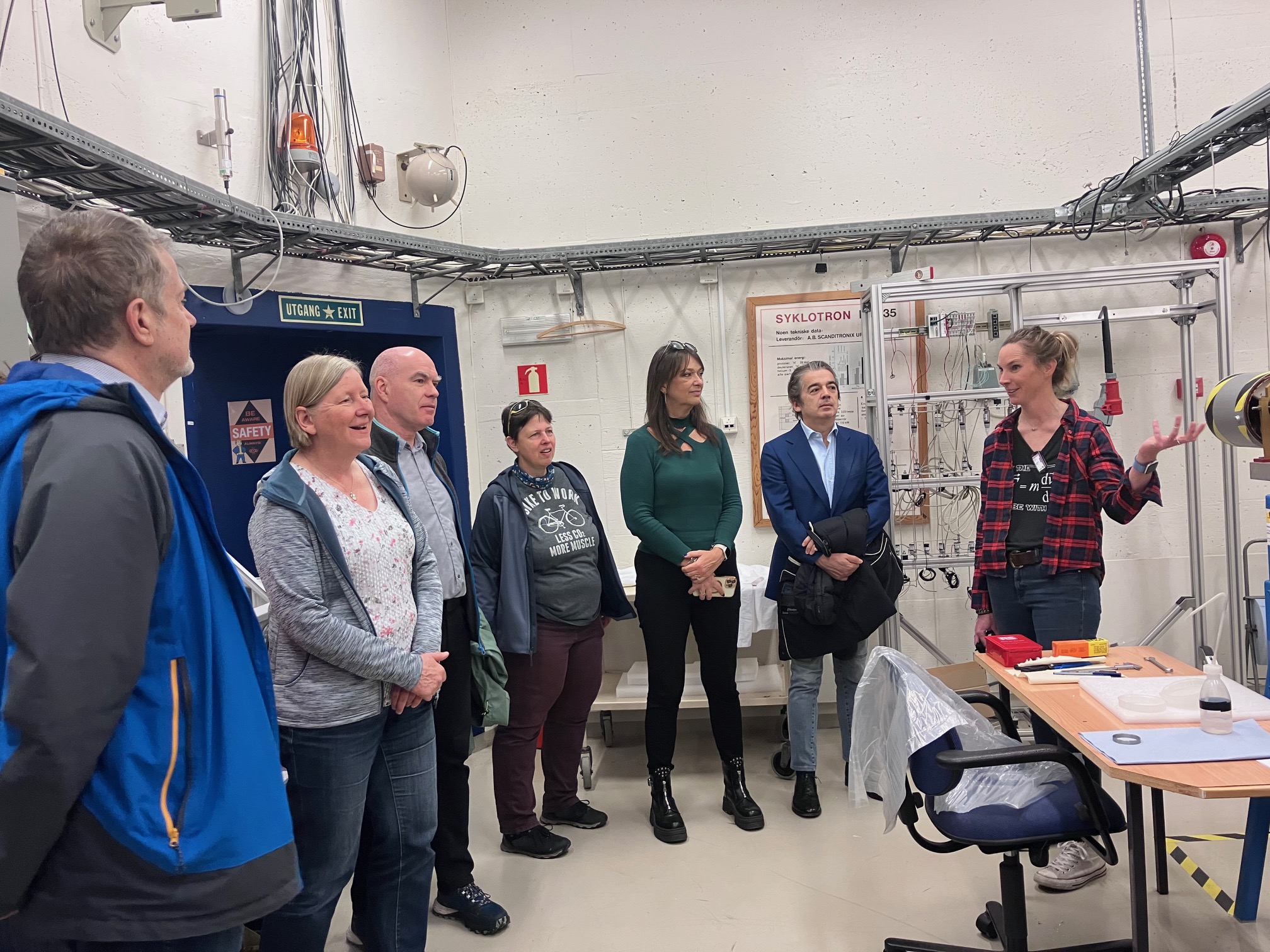
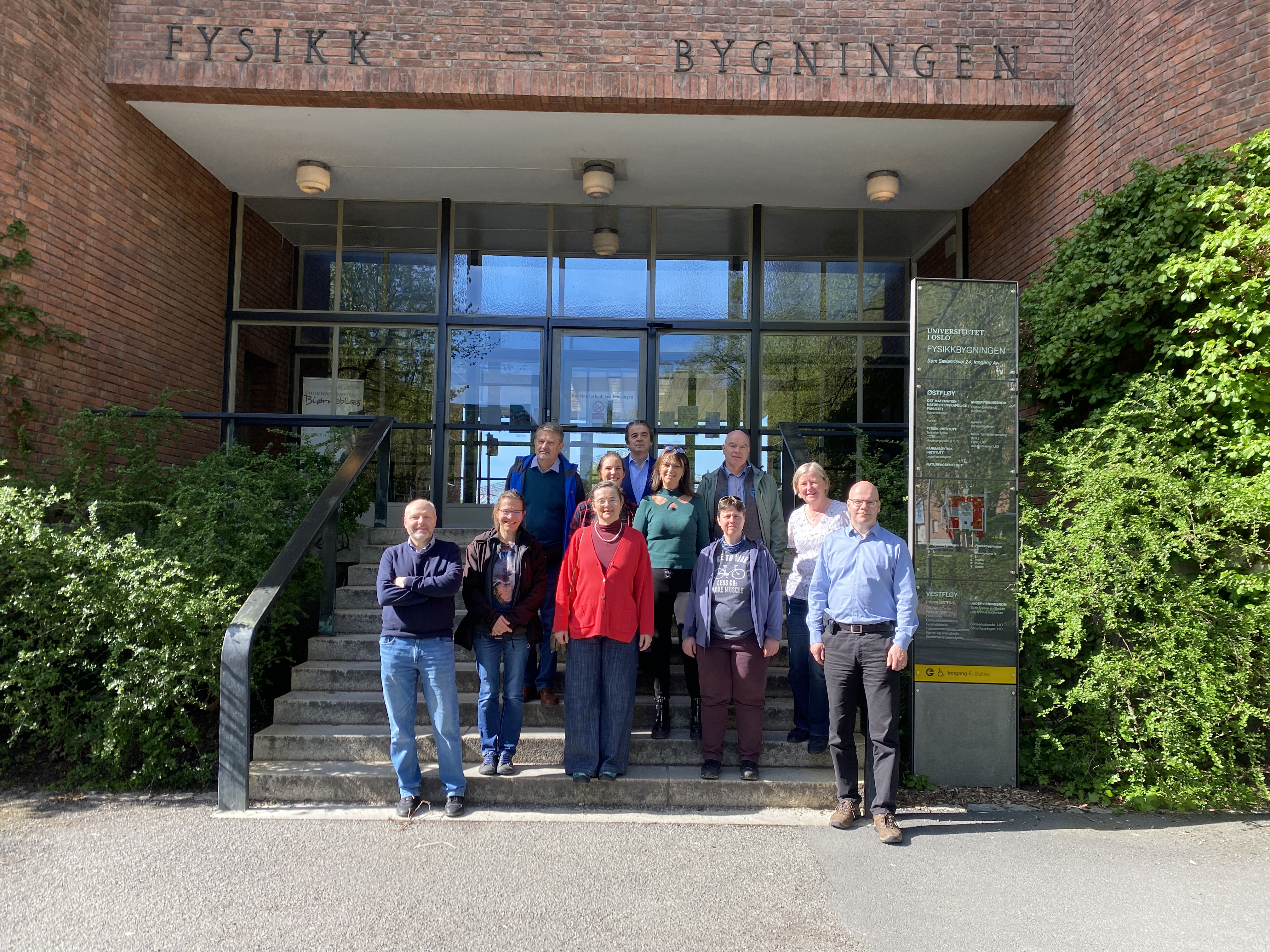
On the following day, the board visited the physics department of the University of Oslo and in particular, the Cyclotron laboratory. Due to maintenance, the board could actually see the heart of the facility: the MC-35 Skanditronix cyclotron, which was installed in 1979 and delivers light ion beams for studies in nuclear physics as well as in biophysics and nuclear medicine. The visit continued with a guided tour of the beam line, which hosts the OSCAR array composed of 30 LaBr detectors. In conjunction with segmented Si junctions for light particle detection, this device is used to measure nuclear level densities and gamma-decay strength functions via the world-famous “Oslo” method. These quantities are crucial to test nuclear theories as well as to model the processes that lead to nucleosynthesis in stellar environments.


(by Araceli Lopez-Martens)

This post has not been tagged.

Permalink
 

Call for 2 NPD elected members

Posted By Alessandra Fantoni, Thursday 16 May 2024
Nomination is open for 2 (two) new ordinary board members of the EPS Nuclear Physics Division (EPS-NPD).  


Nomination is open for 2 (two) new ordinary board members of the EPS Nuclear Physics Division (EPS-NPD).  


The members of the Board are expected to attend Board meetings, which take place twice a year. Please note that the newly elected board members will be invited at the fall board meeting in Paris (details will be mailed in due course). 

Some of the activities of the NPD are the following:

 - Organisation of the European Nuclear Physics Conference series,
 - Organisation of the Nuclear Physics in Astrophysics Conference series,
- Organization of the Applied Nuclear Physics Conference series,
- Awarding three prestigious prizes: Lise Meitner Prize, Applied Nuclear Physics Prize (ex IBA Prize) and PhD Thesis Prize.  


The board produces publications on various nuclear physics related topics, for example so called EPS Position Papers and provides input to the EPS on issues related to nuclear physics and relations to other European and international bodies interested in nuclear physics and policy.  


For more information, you may visit the NPD website.
http://www.eps.org/?page=npd  


For a nomination to be valid:
 - the nomination has to be supported by two other Individual Members. They may either sign the nomination form or send a support letter independently by email.
 - it must be accompanied by a statement of consent from the nominee
 - the elected candidate must be or become an EPS Individual Member (https://www.eps.org/general/register_member_type.asp? )
 - the nominee must send a short CV in pdf or .doc 
format
- the nominee must send a half page candidate/campaign statement (length ½ page)
- it must be received at the EPS secretariat (with a copy to the NPD secretariat) by July 26th 2024.
 
Please send it by e-mail to the two following addresses:
     
secretariat@eps.org
zsofi@atomki.hu
 
For a nomination, the attached form or a copy may be used.
 

 Attached Files:

This post has not been tagged.

Permalink
 

Call for nominations for the EPS Nuclear Physics Division Prize for Applied Nuclear Physics 2024

Posted By Administration, Thursday 11 January 2024
Updated: Tuesday 9 January 2024

The call for nominations for the EPS Nuclear Physics Division Prize for Applied Nuclear Physics 2024 is now open.

Details about nominations can be found here.

The deadline is 31st March 2024 => postponed to 30th April 2024

This post has not been tagged.

PermalinkComments (0)
 

Call for EPS NPD PhD Prize 2024

Posted By Administration, Tuesday 9 January 2024

The call for the EPS NPD PhD Prize 2024 is now open. Details about nominations can be found here.

The deadline for nominations is 31st March 2024 => postponed to 30th April 2024.

This post has not been tagged.

PermalinkComments (0)
 

The « Institut de Physique Nucléaire » in Orsay distinguished as an EPS Historic Site

Posted By Administration, Thursday 14 December 2023
The « Institut de Physique Nucléaire » (IPN) in Orsay, France, was added to the list of the Historic Sites of the European Physical Society on 13th October 2023.

Read the complete report at: https://www.eps.org/blogpost/751263/496123/.

This post has not been tagged.

PermalinkComments (0)
 
Page 2 of 4
1  |  2  |  3  |  4
Community Search
Sign In
Login with LinkedIn
OR


EPS Privacy Notice :: Contact us