This website uses cookies to store information on your computer. Some of these cookies are used for visitor analysis, others are essential to making our site function properly and improve the user experience. By using this site, you consent to the placement of these cookies. Click Accept to consent and dismiss this message or Deny to leave this website. Read our Privacy Statement for more.
Print Page   |   Contact Us   |   Sign In   |   Join EPS
News
Group HomeGroup Home Blog Home Group Blogs

Celebrating Excellence: EPS Nuclear Physics Awards at EuNPC 2025

Posted By Alessandra Fantoni, Thursday 23 October 2025

Scientific Excellence of the EPS Nuclear Physics Division celebrated at EuNPC2025 in Caen

From 22 to 26 September 2025, the European nuclear physics community convened in Caen, France, for the 6th European Nuclear Physics Conference (EuNPC2025) — the flagship event of the EPS Nuclear Physics Division (NPD). A major highlight of the gathering was the official presentation of the 2024 EPS NPD Prizes, which honoured both established figures and promising young scientists in the field.

Lise Meitner Prize 2024: Honouring Pioneers in Nuclear Science

During the conference’s social dinner, the prestigious Lise Meitner Prize — awarded biennially by the EPS-NPD for outstanding contributions to nuclear science — was jointly presented to:

• Prof. Muhsin N. Harakeh (University of Groningen, Netherlands)

• Prof. Achim Richter (TU Darmstadt, Germany)

On the final day of the conference, both laureates gave keynote lectures showcasing their pioneering work on collective excitations in nuclei, including giant resonances, isospin modes, and the “scissors mode.” Their groundbreaking experimental and theoretical contributions were recognized by the prize committee for their lasting impact on nuclear structure research and accelerator development.

Prof. Achim Richter was not able to attend the conference and Dr Peter von Neumann-Cosel gave the talk on his behalf.

Named in honour of the trailblazing physicist Lise Meitner, the award is one of the most prestigious distinctions in the field. This year’s joint recognition reflects the complementary nature of the winners’ scientific careers and their influence across generations of nuclear physicists.

PhD Thesis Prizes: Celebrating Emerging Talent

Also presented during the conference’s social dinner were the EPS NPD PhD Thesis Prizes for the period 2021–2023, recognising exceptional doctoral research conducted at European institutions.

The three recipients were:

• Dr. Chloé Fougères (University of Caen / GANIL): “Understanding the cosmic abundance of ²²Na: lifetime measurements in ²³Mg”

• Dr. Sandro Fabian Kraemer (KU Leuven): “Vacuum ultraviolet spectroscopy of the radiative decay of the low energy isomer in ²²⁹Th”

• Dr. Francesco Marino (University of Milan / INFN): “Microscopic theory of infinite nuclear matter and non empirical energy functionals”

On the final day of the conference, each awardee presented their thesis work to a broad audience of peers, mentors, and senior scientists. Their presentations spanned nuclear astrophysics, fundamental nuclear structure, and theoretical models of nuclear matter — underscoring the richness and diversity of current research directions.

EPS Poster Prize awarded at the conference

As per tradition, the European Physical Society (EPS) is supporting the EPS Poster Prize.
This year, the Nuclear Physics Division Board has awarded the prize to Dr. Marta Satrazani from KU Leuven for her outstanding work on “Gamma-ray spectroscopy of ²²⁹Ac following the
β decay of ²²⁹Ra” on behalf of the IDS Collaboration.

Additional poster prizes, supported by NuPECC, one of the conference sponsors, have also been presented to other talented young researchers.

A Ceremony Rooted in Community Spirit

The awards ceremony, held during the social dinner at EuNPC2025, was a moment of celebration and recognition. The laureates’ presentations on the final day provided the entire conference community with the opportunity to engage directly with the scientific achievements being honoured.

“These awards are more than symbolic,” commented Alessandra Fantoni, the chair of the EPS-NPD Board. “They represent the creativity, depth, and continuity of the nuclear physics community in Europe and beyond.”

Lise Meitner laureates  Achim Richter (represented by Peter Von Neumann-Cosel) and Muhsin Harakeh 

with Alessandra Fantoni (EPS NPD chair and EuNPC2025 co-chair) and Marek Lewitowicz (EuNPC2025 co-chair)


 PhD best thesis Chloe Fougères with Alessandra Fantoni (EPS NPD chair and EuNPC2025 co-chair) and Marek Lewitowicz (EuNPC2025 co-chair)

 PhD best thesis Sandro Kramer with Alessandra Fantoni (EPS NPD chair and EuNPC2025 co-chair) and Marek Lewitowicz (EuNPC2025 co-chair)

 PhD best thesis Francesco Marino with Alessandra Fantoni (EPS NPD chair and EuNPC2025 co-chair) and Marek Lewitowicz (EuNPC2025 co-chair)  


 Best EPS poster prize Marta Sartrazani with Alessandra Fantoni (EPS NPD chair and EuNPC2025 co-chair)


Tags:  award  EPS NPD  EuNPC  European Nuclear Physics Conference  Lise Meitner Prize  Phd prize 

Permalink
 

Call for bids European Nuclear Physics Conference 2027 (EuNPC 2027)

Posted By Alessandra Fantoni, Tuesday 1 April 2025
Updated: Monday 24 March 2025

The board of the Nuclear Physics Division (NPD) of the European Physical Society (EPS) is seeking candidates to host the 2027 edition of the European Nuclear Conference (EuNPC 2027).


Every three years the European Nuclear Physics Conference brings together researchers together with the aim to review and discuss the status and prospects in the field of nuclear physics and its applications. The conference will be a showcase for forefront theoretical and experimental developments, where the interplay between outstanding research and innovative concepts in the field will be promoted.

The EuNPC conference is part of the series of NPD divisional conferences, comprising the Nuclear Physics in Astrophysics (NPA) and the Applied Nuclear Physics (ANP) Conferences.

The application material should include:

-              the approximate dates when it is planned to hold the conference,

-               the description of the proposed location and venue,

-              the description of the participating Universities and Laboratories,

-              the projected costs,

-              the expected financial supports,

-              the anticipated sponsorship from Universities/Laboratories/Industries,

-              the support for students and early career researchers,

-               and the foreseen approximate conference fees.


The scientific program should cover the following fields:

·      Accelerators and Instrumentation

·      Nuclear Structure, Spectroscopy, and Dynamics

·      Nuclear Astrophysics

·      Astroparticle Physics

·      Heavy Ion Collisions and QCD Phases

·      Hadron Structure, Spectroscopy, and Dynamics

·      Fundamental Symmetries and Interactions

·      Nuclear Physics Applications

·      Few-Body Systems


The bid should also provide the list of members composing the Local Organizing Committee.

As the EuNPC is part of the series organized by the Nuclear Physics Division:

  • a reduced fee for EPS members should be considered
  • a contribution of €25 per participant is expected to be provided to the NPD board
  • all NPD board members should be included in the International Advisory Committee and as session conveners.


In the case of proceedings, it is strongly recommended to select those appearing on a referred journal. The procedure should be defined in advance, and the proceedings must be accessible to all conference speakers.

The conference could apply to be recognized as an EPS conference and may also request an EPS poster prize and/or a grant for early-career researchers.


The EuNPC 2027 is expected to have a special session dedicated for the EPS-NPD awards, in particular the Lise Meitner 2026 and the best PhD theses for the period 2024-2026 prizes. The winners of the prizes will be invited at the conference to present their work.


The deadline to submit the application material to the Scientific Secretary of the NPD board (Raquel Crespo,  raquel.crespo@tecnico.ulisboa.pt) is July 31st, 2025.

The candidates will be invited to present their proposal at the NPD board meeting in September 2025, when the selection of the EuNPC 2027 conference will be made and announced at the end of the EuNPC 2025 conference in Caen from September 22nd to 26th, 2025.


Tags:  award  bid  call  EPS NPD  EuNPC  European Nuclear Physics Conference  Lise Meitner Prize  Phd prize 

Permalink
 

Lise Meitner Prize 2024

Posted By Alessandra Fantoni, Friday 28 February 2025
Updated: Sunday 23 February 2025

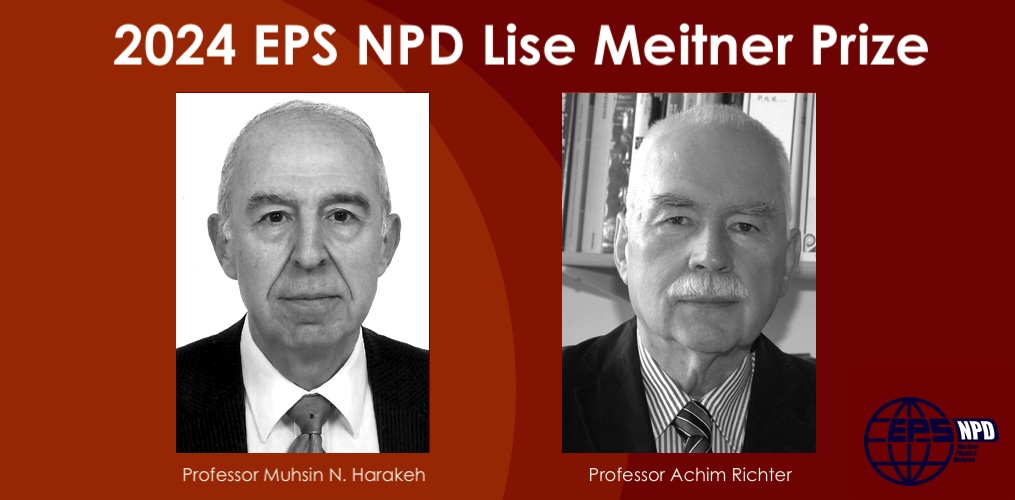
The Nuclear Physics Division (NPD) of the European Physical Society (EPS) is delighted to announce that the winners of the 2024 Lise Meitner prize are Prof. Dr. Muhsin N. Harakeh (University of Groningen - Netherlands) & Prof. Dr. Dr. h.c. mult. Achim Richter (Technical University of Darmstadt - Germany).

The prize is given every two years for outstanding work in the fields of experimental, theoretical or applied nuclear science. Professors Harakeh and Richter are both renowned figures in nuclear physics, having made significant discoveries over decades of dedicated research. Their contributions have influenced the entire scientific community in this field.

Prof. Harakeh and Prof. Richter have been awarded the prize for their seminal contributions to the discovery and investigation of collective modes in atomic nuclei, including the Isoscalar Giant Monopole and Dipole Resonances and the "Scissors Mode”, and the role of the isospin degree of freedom in nuclear excitations. Their work has also driven significant methodological advancements, such as zero-degree measurement techniques and the development of multi-turn superconducting linear accelerators.

The prize will be awarded on 22-26 September 2025 during the 6th European Nuclear Physics Conference 2025 (EuNPC 2025) in Caen (France), where the winners will give a talk on their research.


More info:

- 2024 call and previous winners available here

- A brief article on Lise Meitner is available here

Tags:  2024  award  EPS NPD  EuNPC  Lise Meitner Prize  nuclear science 

Permalink
 

Highlights of the EuNPC2022 conference

Posted By Alessandra Fantoni, Friday 9 December 2022

The 2022 edition of the European Nuclear Physics Conference (EuNPC), organized by the Nuclear Physics Board of the European Physical Society, took place, from 24th to the 28th of October 2022, in the beautiful Spanish city of Santiago de Compostela. It was the 5th edition of the EuNPC series, after the ones in Bochum, Bucharest, Groningen, and Bologna, and it gathered more than 200 participants from all over Europe, and beyond.

During five intense days, plenary and parallel talks provided the latest news on the themes dealt by the Nuclear Physics Division of EPS, such as nuclear structure and dynamics, heavy Ion collisions, theory and phenomenology, accelerators and applications.

Besides the scientific talks, four special sessions were held, two of which were devoted to award ceremonies and two to the EPS “Young Minds” project. The Lise Meitner Prize, which is given every two years for outstanding work in the fields of experimental, theoretical or applied nuclear science, was awarded to Prof. Phil Walker (University of Surrey). Prof. Walker earned the prestigious prize for his seminal contributions to the understanding of long-lived nuclear excited “isomeric” states and the factors that determine their half-lives, that range from nanoseconds to years. The PhD Prize, recognizing the excellence of a recent PhD thesis in experimental, theoretical or applied nuclear physics, was awarded to three young promising scientists: Giuliano Giacalone, for his thesis “Observing the shape of nuclei at high-energy colliders”; Jonas Karthein (“High-precision measurements in the direct vicinity of the doubly magic 100Sn (N=Z=50) at ISOLDE/CERN”); Ágota Koszorús (“Laser spectroscopy at the frontiers of RIB production”). The sessions devoted to the Young Minds (YM) project, which aims at boosting the career and the scientific creativity of young physicists around Europe and fostering the creation of an international network of young and motivated researchers, consisted in a roundtable on “Life beyond the PhD, a guide to a satisfactory professional career” and a workshop on “Well-being and Positive Mental Health in research career”. Both these sessions saw an important participation of young scientists, interacting actively with the panelists.

More information on EuNPC2022 can be found on the conference web site: https://indico.cern.ch/event/1104299/

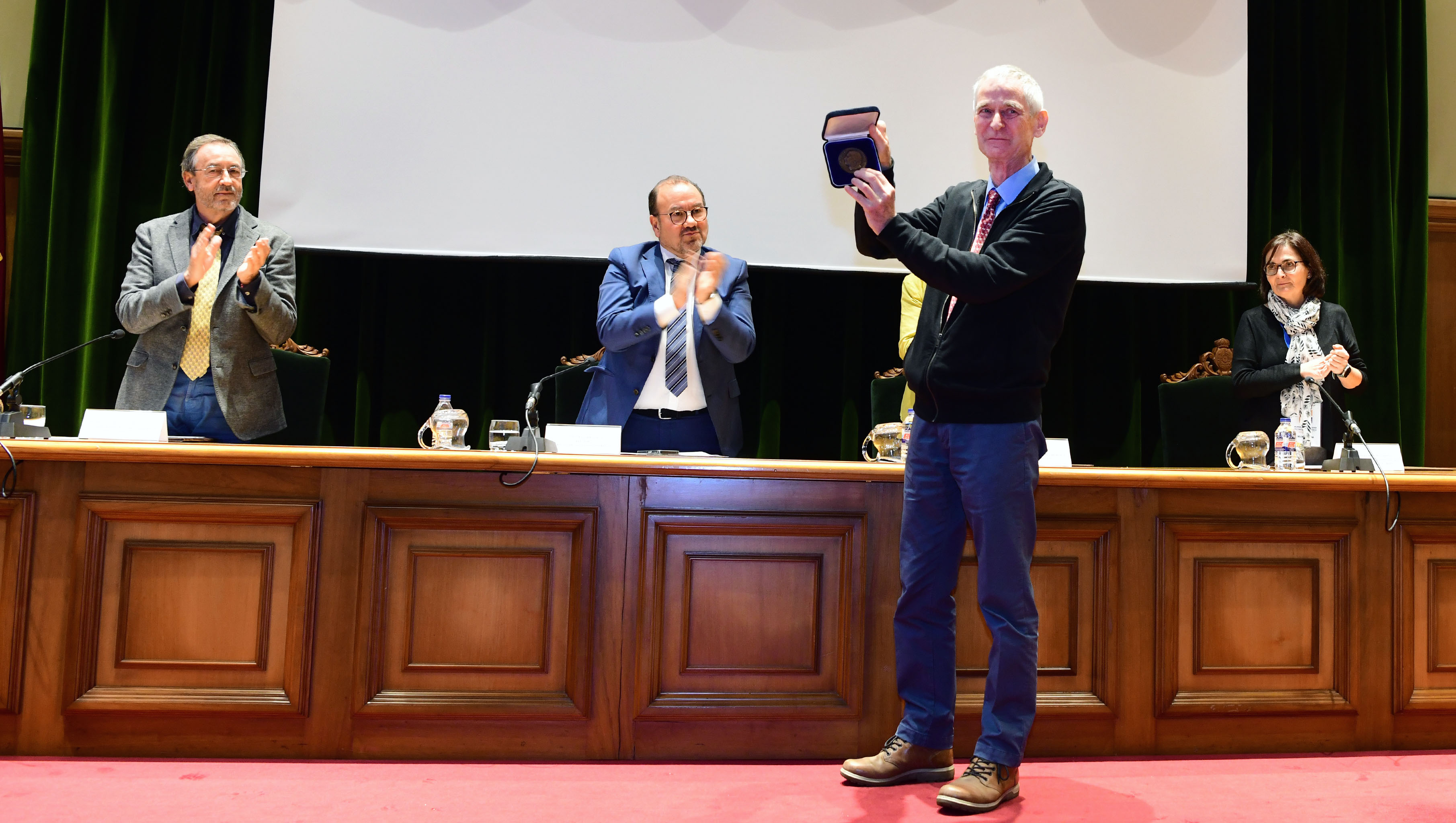
Prof. Phil Walker receives the Lise Meitner Prize

 From left to right: Prof. Miguel A. Sanchis Lozano (Vice chair of the RSEF), Prof. Alison Bruce (Chair of the EPS-NPD board), Prof. Antonio López Díaz (Chancellor of USC), Prof. Phil Walker, and Prof. Dolores Cortina, head of the EuNPC22 Local Organizing Committee.

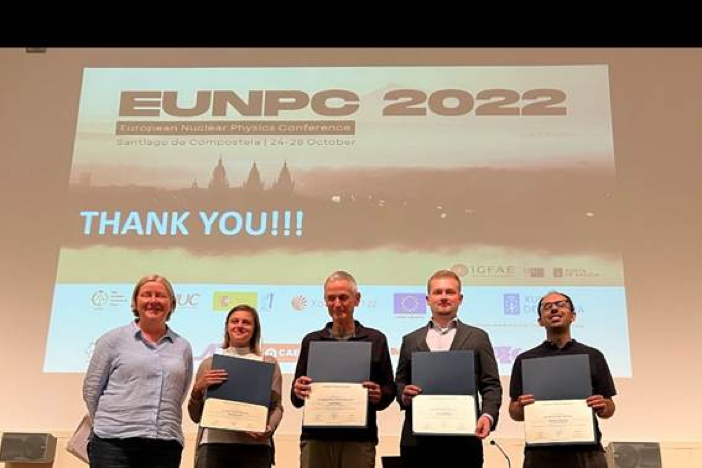
From left to right: Prof. Alison Bruce (Chair of the EPS-NPD board), Dr. Ágota Koszorús, Prof. Phil Walker, Dr. Jonas Karthein, Dr. Giuliano Giacalone.

Tags:  2022  award  EPS NPD  EuNPC  European Nuclear Physics Conference  Lise Meitner Prize  Phd prize  Santiago de Compostela 

PermalinkComments (0)
 

The 2022 EPS NPD Lise Meitner awarded to Philip Walker

Posted By Administration, Friday 15 July 2022
Updated: Friday 15 July 2022

The Nuclear Physics Division of the European Physical Society (EPS) is delighted to announce that the winner of the 2022 Lise Meitner prize is Prof. Phil Walker (University of Surrey). The prize is given every two years for outstanding work in the fields of experimental, theoretical or applied nuclear science and Prof. Walker has been awarded the prize for seminal contributions to the understanding of long-lived nuclear excited “isomeric” states and the factors that determine their half-lives, that range from nanoseconds to years.

Since their discovery by Otto Hahn 100 years ago, isomers have been a cornerstone of our understanding of nuclear structure. These long-lived nuclear excited states give access to the basic physics of both the collective and the individual-nucleon behaviour of nuclei, together with important applications in diverse areas including astrophysics, medical imaging, Mössbauer spectroscopy, time keeping, coherent gamma-ray emission, and energy storage. Walker’s research has a strong focus on the basic properties of isomers, and how these might be exploited for energy applications. He has led the way in recognising and developing novel techniques for revealing isomer structures. For example, in his early work Walker used gamma-ray spectroscopy with pulsed beams to establish some of the most isomer-rich structures in hafnium (Z=72) and tantalum (Z=73) isotopes. Walker worked on isomer theory to predict the existence of some exceptional long-lived isomers in neutron-rich isotopes of the same elements. Although out of experimental reach at the time, such isomers could later be studied, as proposed and led by Walker, using projectile-fragmentation reactions to inject isomers into the new and unique heavy-ion storage ring at GSI in Germany. The new isomers discovered by this method could themselves be revealed in more detail following deep-inelastic reactions and exploiting a new design of isotope separator at RIKEN in Japan. Key experiments have been proposed and led by Walker. This latter work is ongoing, with important results already published.

A controversial aspect of research into nuclear isomers is the possibility that their energy-storage capability could be exploited and, crucially, that it might be possible to release the stored energy in a controlled manner. The high energy density of isomers (≈1 MeV per atom, compared to chemical energies ≈1 eV per atom) could lead to dramatic applications. Walker has been a keen advocate of the science challenges in this area, requiring research at the interface between atomic physics, plasma physics and nuclear physics. New and exciting opportunities are being opened up at FAIR, FRIB and other next-generation radioactive-beam facilities.

Prof. Walker has made outstanding developments in the study and understanding of isomeric states  including critical insights into possible isomer applications, such as energy storage and coherent gamma-ray emission. He has also led in the development and exploitation of a range of experimental techniques, from low-energy isotope separators to high-energy storage rings, which will also extend the isomer research opportunities with the new generation of radioactive-beam facilities.


More info

Tags:  2022  award  EPS NPD  Lise Meitner Prize  nuclear science 

Permalink
 
Community Search
Sign In
Login with LinkedIn
OR


EPS Privacy Notice :: Contact us