This website uses cookies to store information on your computer. Some of these cookies are used for visitor analysis, others are essential to making our site function properly and improve the user experience. By using this site, you consent to the placement of these cookies. Click Accept to consent and dismiss this message or Deny to leave this website. Read our Privacy Statement for more.
We are pleased to announce that the winner of the ESPD Media of the Month contest for November is Franziska Zeuner (Istituto Ricerche Solari di Locarno), with the following visualisation of the Second Solar Spectrum:
Description: This image compiles the visible part of the solar intensity spectrum (left) and the corresponding linear polarization at the solar limb (right). The intensity spectrum is coloured to mimic a spectrograph observation, while the linear polarization is proportional to the brightness. The linear polarization origins from scattering processes in the solar atmosphere and peaks at the solar limb. It is usually referred to as the Second Solar Spectrum. A few spectral lines show pronounced linear polarization signals, like Ca I at 4227 Å and Sr I at 4607 Å. Additionally, the continuum is increasingly linearly polarized towards the blue part of the spectrum, where scattering is very efficient. To show more details, the polarized spectrum is saturated, indicated by the cyan color. The spectra were observed with the ZIMPOL polarimeter at the IRSOL telescope in Locarno, Switzerland. Instrument: IRSOL 0.45-m Solar Telescope with the Zurich IMaging Polarimeter (ZIMPOL), wavelength range: 450 - 650 nm
The data for this image have been provided in electronic form by IRSOL as a compilation by Stenflo (2014), based on the atlas of Gandorfer (2000, 2002, 2005).
We are pleased to announce that the winner of the ESPD Media of the Month contest for October is Lakshmi Pradeep Chitta (Max Planck Institute for Solar System Research), with the following image of the solar corona:
Description: This image shows solar corona covering an active region observed using the Atmospheric Imaging Assembly (AIA) on the Solar Dynamics Observatory (SDO) on 2017 JUly 12. The field of view is approximately 580 Mm x 435 Mm. The various structures are created by coronal plasma that is trapped by magnetic fields. Owing to its high temperatures, often exceeding a million degrees Kelvin (MK), coronal plasma, composed of highly ionized atoms (e.g. Fe XII, Fe XV), emits brightly in the extreme ultraviolet (EUV) wavelengths. The image is a composite of three images captured by three different EUV filters on AIA. The red (~ 5 MK), blue (~ 1-2 MK), and green (< 1 MK) shaded regions highlight plasma features at different temperatures. The origin of such high coronal temperatures is still a mystery.
We are pleased to announce that the winner of the ESPD Media of the Month contest for September is Kevin Reardon (National Solar Observatory), with the following image of the chromosphere of an active region:
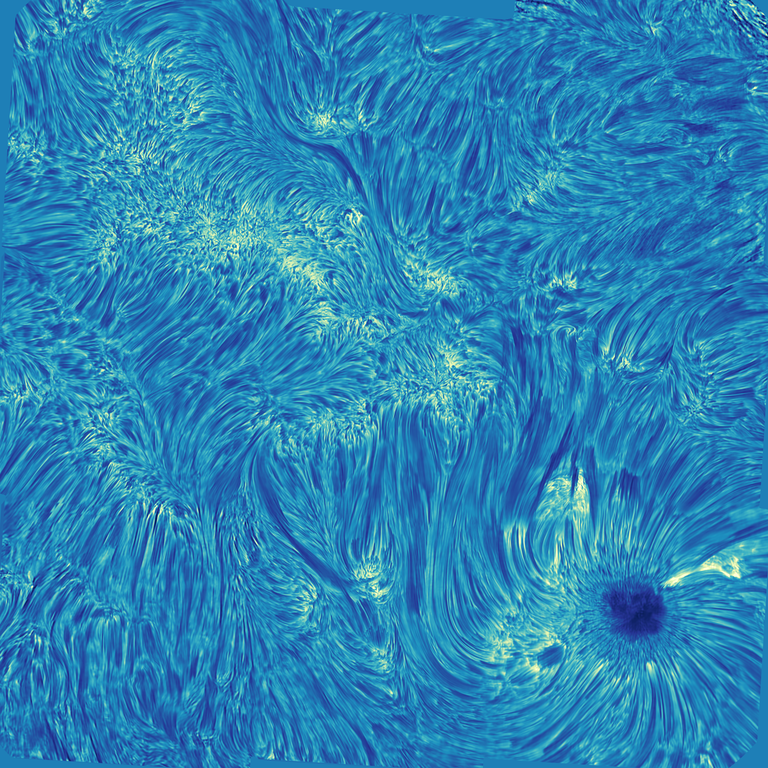
Description: This is an image of solar chromosphere covering 166 Mm x 166 Mm taken in the core of the Hydrogen-alpha 6563 Å spectral line with the Interferometric Bidimensional Spectrometer (IBIS) at the Dunn Solar Telescope, operated by the National Solar Observatory, in Sunspot, New Mexico. It shows the dark sunspot, but also many fibrils which are thought to indicate the expanding magnetic field connecting regions of opposite magnetic polarity.
We are pleased to announce that the winner of the ESPD Media of the Month contest for August is Luc Rouppe van der Voort (University of Oslo), with the following image of spicules:
Description: This image was observed with the SOUP instrument at the Swedish 1-meter Solar Telescope (SST) on La Palma (Spain) and shows spicules close to the solar limb. Spicules are thin, elongated jets of a few hundred kilometers wide. They reach up to 6000 km height and can move at speeds of more than 100 km/s. Spicules are found all over the solar surface, but can be observed most easily near the limb of the Sun.The image is taken at a Doppler offset of +0.07 nm in the red wing of the H-alpha spectral line.
We are pleased to announce that the winner of the ESPD Media of the Month contest for July is Jean-Marie Malherbe (LESIA, Observatoire de Paris), with the following historical image of a prominence:
Description: On May 27th-29th 1919, more than 101 years ago, a massive prominence could be observed above the solar limb by the Meudon Spectroheliograph in the H-alpha line. These historical images show the evolution of the structure of the prominence during several days. Prominence magnetized structures consist of plasma hundred times more dense than the surrounding coronal plasma. Prominences may persist in the corona for several weeks. Some prominences may erupt, their material being violently ejected towards the interplanetary medium. While nowadays multiple space and ground-based instruments are continuously monitoring the activity of the Sun, imaging of the solar active phenomena has been made routinely since the beginning of the 20th century. One of these early instruments is the Meudon spectroheliograph, which, since its invention by Henri Deslandres in 1892, has been and is still recording solar chromospheric filaments and prominences. Starting from 1909, the Meudon spectroheliogram collection is one of the most complete in the world. The systematic observation of the Sun is still an active public service of the Observatoire de Paris.
We are pleased to announce that the winner of the ESPD Media of the Month contest for June is Luc Rouppe van der Voort (University of Oslo), with the following movie of a sunspot observed by the Swedish 1-m Solar Telescope:
Description: The movie shows the main sunspot in active region AR 11084 observed with the Swedish 1-m Solar Telescope (SST) on La Palma (Spain). Sunspots are regions with strong magnetic fields. The central dark area, the umbra, has the strongest and most vertical magnetic fields. The dark umbra is surrounded by the filamentary penumbra where magnetic fields are more horizontal. Note that the black line in the top measures 10,000 km on the Sun. Instrument: Swedish 1-m Solar Telescope / Blue Tower wideband (wavelength 395.4 nm) target: sunspot in AR11084 (x,y) = (59",-414"), 2-Jul-2010 movie duration: 1 hour. Observers: Mats Carlsson and Viggo Hansteen (University of Oslo, Norway). Data reduction: Luc Rouppe van der Voort (University of Oslo, Norway)
We are pleased to announce that the winners of the ESPD Media of the Month contest for May are Vasco Henriques and Ainar Drews (University of Oslo), with the following image of the solar chromosphere at high resolution:
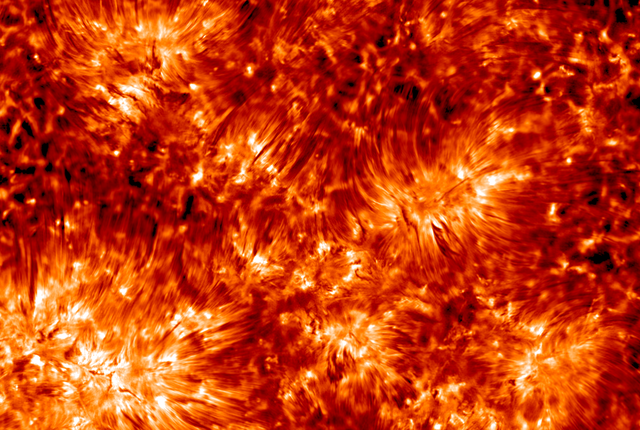
Description: Here we see the sun's mid-atmosphere, the chromosphere, face on. These observations are targeting a region of moderate magnetic activity. The inner blue-wing of the Ca II K 393.4 nm line is imaged with a 13 nanometer bandpass using the CHROMIS double Fabry–Pérot instrument at the Swedish 1-meter Solar Telescope on the 25th of May, 2017. The darker regions feature a hydrodynamic web-like pattern known as "reverse granulation" with a contribution from propagating bright shock-fronts. In between these areas, clusters of bright points can be seen where bright arching fibrils seem to be anchored on. These fibrils are elongated and very slender when imaged in this wavelength, as slender as 0.1 arcsec or less than 75 km wide in this image. This is how finely we can observe the chromosphere of the Sun as of early 2020. Observations such as these help us understand the most complex region of the solar atmosphere and how mass and energy are transported between the surface of the sun and the multi-million degree corona.
The European Solar Physics Division (ESPD) of the European Physical Society is honored to announce that Eric Priest (University of St Andrews, UK) has been awarded the ESPD Senior Prize 2020.
The prize is awarded for:
" long-standing leadership via mentoring, supervising and field-defining textbooks and for fundamental contributions in key topics of solar magnetohydrodynamics, particularly magnetic reconnection in the solar atmosphere and solar coronal heating."
The ESPD board wishes to thank the members of the senior prize selection board for their time and expertise: Luis Bellot Rubio, Manolis Georgoulis, Louise Harra, Åke Nordlund Lidia Van Driel-Gesztelyi.
Eduard Kontar (ESPD President) and Étienne Pariat (ESPD Prize Committee Chairperson)
We are pleased to announce that the winner of the ESPD Media of the Month contest for April is Daniel Nóbrega-Siverio (University of Oslo), with the following image of a coronal jet and surge in a radiation-MHD numerical simulation:
Description: This figure shows a snapshot from a solar bidimensional radiation-magnetohydrodynamic (R-MHD) numerical experiment by Nóbrega-Siverio et al. (2017, 2018) carried out using the Bifrost code (Gudiksen et al. 2011). In the left panel, a temperature, T, map from that simulation is shown, spanning from the upper layers of the convection zone up to the solar corona, where the location of the solar surface is indicated with a dash line at Z=0 Mm. In that panel, we can distinguish a dome-like structure that corresponds to a new emerged plasma that has raised from the solar interior and that is now being reconnected with the pre-existing coronal magnetic field. As a consequence of this magnetic reconnection process, two ejections are produced: a hot collimated coronal jet with an inverted-Y shape (or Eiffel tower) that reaches more than 1 MK; and a non-collimated ejection with a fang shape, known as surge, composed by cool plasma. The middle panel contains a map of the vertical velocity, uz, for the same instant and domain illustrated in the left panel. This panel shows that the coronal jet reaches velocities of more 150 km/s, in fact, the upwards velocities are up to 300 km/s (the color scale is saturated), while the surge has downward velocities, as maximum, of -50 km/s. The right panel contains a zoom out for the previous panel to highlight the reconnection site and the bidirectionial flow that leads to the hot coronal jet.
The European Solar Physics Division board is delighted to present the 2020 ESPD Prize winners:
PhD Thesis Prize to Dr. Stefan Hofmeister(PhD carried at Institute of Physics, University of Graz, Austria) - Prize awarded for outstanding observational analysis of solar coronal holes, their magnetic fine structure and the associated high-speed solar wind streams.
Early Career Researcher Prize to Dr. Victor Réville (currently working at IRAP, France) - Prize awarded for fundamental contributions to creating self-consistent multi-dimensional numerical models of coronal heating and solar wind acceleration via wave turbulence.
 Print Page
 Group Home
 Blog Home
 Group Blogs
 RSS
RSS