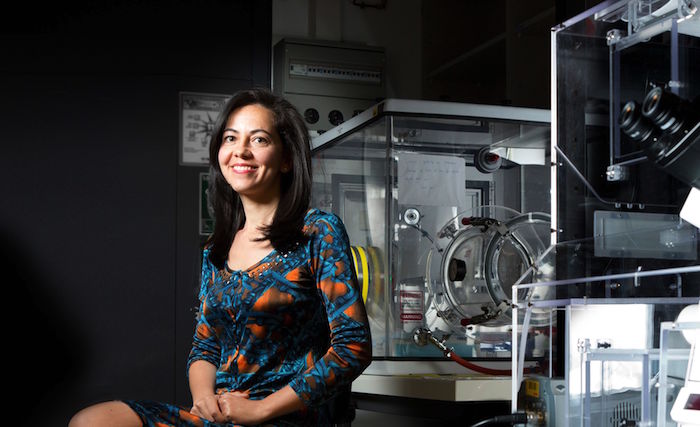
Author: Luc Bergé
Maria Viñas’s research focuses on the physics of vision and vision
psychophysics, with Adaptive Optics based visual technologies to image
the eye, and study visual function and neural adaptation in
polychromatic conditions under a very wide range of
artificially-simulated-conditions. Her work on Adaptive Optics visual
simulation in polychromatic conditions has contributed to different
areas of research in Visual Optics and Biophotonics, like the study of
chromatic aberrations in phakic and pseudophakic eyes and their impact
on vision, the optical, visual and neural effects of astigmatism, the
experimental simulation of complex multifocal solutions for Presbyopia,
and the pre-operative simulation of post-operative multifocal vision
with those corrections. Maria Viñas completed undergraduate studies in
Optics and Optical Engineering in the Complutense University of Madrid
(UCM), followed by a predoctoral work at the Visual Optics &
Biophotonics Lab, where she obtained her PhD in Physics in 2015. She is
currently an IF-MSCA fellow with a joint position at the Wellman Center
for Photomedicine, Massachusetts General Hospital and Harvard Medical
School (USA) and the Institute of Optics of the Spanish National
Research Council (Spain). She is also founding member of the spin-off
company, 2EyesVision, which develops clinical visual simulators.
Maria
Viñas received several recognitions from scientific societies (OSA,
ARVO). In particular, she was elected OSA Ambassador of The Optical
Society (OSA) in 2019. She is past president of IOSA - Institute of
Optics OSA Student Chapter - where among a wide range of activities she
has authored a very successful book of optical experiments. She is
currently the vice-chair of the Visual Sciences Committee of the Spanish
Optical Society, and chair of the Women in Optics and Photonics
committee of the Spanish Optical Society, where she fights gender
stereotypes in science, technology, engineering, and mathematics (STEM).
Luc Bergé, President-Elect of the EPS and chair of the EPS Equal Opportunity Committee (LB), interviewed Maria Viñas (MV).
LB: Why did you choose to study physics?
MV:
I actually studied Optics and Optical engineering at the University
Complutense of Madrid. However, I became more and more interested in the
Optics/Physics behind the visual process and related technologies. That
is why, when I finished my Master’s degree, I joined the Visual Optics
and Biophotonics Lab of the Institute of Optics of the Spanish National
Research Council (CSIC). The group, led by Prof. Susana Marcos, had a
research line focused on the use of Adaptive Optics technologies,
inherited from astronomy and only very recently focused on visual
Optics, in order to study the optics of the eye and how the brain sees
the world through it. I was fascinated by that topic. The same
technology used to image the stars could be used to image the eye! Also,
I did my PhD there, developing novel Adaptive Optics systems to study
visual function and to improve optical corrections for visual problems,
like Myopia or Presbyopia. And I am really happy to see that some of
those technologies have jumped from the lab to the clinic, via a
spin-off company, 2EyesVision, which I co-founded. Now, I am really
excited to keep pursuing novel breakthroughs in the new phase of my
career, starting now as an IF-MSCA fellow with a joint position at the
Wellman Center for Photomedicine, Massachusetts General Hospital and
Harvard Medical School (USA) and the Institute of Optics of the Spanish
National Research Council (Spain).
LB: Any worry to match your family life and a career in physics?
MV:
Funny timing for that question, since I am now a postdoctoral
researcher with a 5 months old baby, and that fact has a real impact on
my work/life balance. I was not worried about this before; I did not
even think much about it. I could see my female colleagues struggle, but
I did not relate much. Now I am facing the real truth, I can say that
this situation is hard, but doable.
We all know that research
provides a very competitive environment, which requires carrying a high
workload and a lot of travelling, among other things. Numbers of female
scientists in STEM tell us that the struggle is higher for women. This
happens even before we consider having a family; it is deeply related to
gender stereotypes that affect us all. Also, the number of female
scientists in STEM areas is lower, because of the work/life balance,
which is typically harder to maintain for women. However, I am
optimistic about the future. Things are changing. Research/Academic
institutions are making an effort to attract female talents to STEM and
to maintain it by offering more flexibility, looking for strategies that
enable more diverse research teams or fighting stereotypes. There is
still much to be done, but I really think if you want to pursue a career
in STEM, this issue must not discourage you. It is so much fun to work
in the lab (as Prof. Donna Strickland said in her Nobel Prize
presentation) than the rest can be overcome.
LB: Are you worried about finding a job in physics?
MV:
I think when you are at a postdoctoral stage you certainly worry about
this. There are many options to explore, and you can join truly amazing
groups and develop very interesting projects. However, getting a
permanent position, in such a way that you can develop your own
independent projects and lead your research group is not so easy. I
think this is a common worry for many researches at this time: you love
your work, which is quite exciting, but your career is not as stable as
you’d like. In my case I have been very lucky so far, I cannot complain.
LB: What has been the personally most rewarding experience and also the biggest difficulty encountered so far in your career?
MV:
For me the biggest difficulty was the beginning. After graduating, I
started working in Industry, nothing related to research. However, I
desired something else. I knew I had found my path when I started my
PhD. I really like what I do. My most rewarding experiences have to do
with teaching, not only my students in the lab, but also students in the
University or children in outreach activities. How their curiosity
awakes, how they grow scientifically, is very rewarding.
LB:
Did you encounter any difficulty in finding funding for PhD or a
post-doc position related to the fact that you are a woman?
MV:
I was unaware of gender bias during my pre-doctoral years; I was happy
because I could focus on Science, only lab stuff mattered. However,
becoming a postdoctoral researcher changed my perception of things.
Scientific structures are more willing to incorporate male scientists
than female ones. Scientific networking is male dominated, how positions
are achieved, how connections are made…When you are the female
scientist in the room is always more difficult to make your voice heard,
no matter your experience, no matter your seniority, this can undermine
your confidence as a scientist. But I think that things are changing;
research groups are more and more diverse, which helps fighting gender
discrimination.
LB: Any suggestion to guarantee a balanced gender representation in physics?
MV:
For me the important thing here is to fight against gender stereotypes,
which are at the very centre of the problem. This is not only a
question of getting a balanced gender representation in physics, it is
also a problem that affects society as a whole, and which we should be
fighting together. Reducing unconscious bias is the real deal.
LB: Any particular advice for a young aspiring researcher?
MV: Enjoy what you do. A research career is tough, but it is also worthwhile.
LB: Do you have any female ‘physicist cult figure’ or ‘role model’?
MV:
Yes, I have been very lucky in that regard. I had a great professor
during my Master, Prof. Maria Luisa Calvo from the School of Physics of
the Complutense University of Madrid, who was truly inspiring. She went
on being a great mentor along the years. Of course, my PhD supervisor,
Prof. Susana Marcos from the Institute of Optics of the Spanish National
Research Council (CSIC), who taught me almost everything I know on
visual optics and about being a scientist, always supported me to
develop novel breakthrough projects.
 Print Page
 Blog Home
 All Blogs
 RSS
RSS