|
|
Posted By Administration,
Monday 16 March 2020
Updated: Monday 16 March 2020
|
author: Institute of Physics

Professor Qi-Kun Xue
The Institute of Physics (IOP) and IOP Publishing (IOPP) have appointed Professor Qi-Kun Xue as chief scientific advisor for China.
In the newly created role, Professor Xue will support the IOP and IOPP as they continue to strengthen relationships with the scientific community in China. He will advise on strategic engagement with key decision makers in government and the scientific community and provide expert insight into political and institutional processes. He will also lead a new Science Advisory Board made up of distinguished academic and industry professionals, which has been formed by the organisations to provide guidance on developments in research and academic publishing throughout China.
Professor Xue is currently Vice President of Tsinghua University, Beijing and President of Beijing Academy of Quantum Information Sciences (BAQIS). He is also a Vice-President of the Chinese Physical Society.
He received his BSc from Shan-Dong University in 1984 and his PhD in condensed matter physics from the Institute of Physics of the Chinese Academy of Sciences (IOPCAS) in 1994.
His academic career began as a Research Associate at the Institute for Materials Research, Tohoku University, Japan. He progressed to Visiting Assistant Professor in the Department of Physics at North Carolina State University in 1996. Xue received his professorship from IOPCAS in 1999 and moved to the Department of Physics, Tsinghua University as a Distinguished Professor, in 2005.
In 2016, he was the first recipient of the Physical Science Award of the new Future Science Prize – China’s first non-governmental science award – for his ground-breaking discoveries of novel quantum phenomena using molecular beam epitaxy, including quantum anomalous Hall effect (QAHE) and monolayer FeSe superconductivity.
Commenting on his appointment, Professor Xue, said: “Thanks to substantial investment, and the hard work and dedicated focus of its research community, China is at the forefront of science globally. I am very proud to be helping the Institute of Physics and IOP Publishing in their efforts to forge closer working relationships with the scientific community in China.”
Professor Paul Hardaker, Chief Executive Officer at the Institute of Physics, said: “We are honoured that Professor Xue has agreed to become our first chief scientific advisor for China. It’s extremely important for us to strengthen and develop our links with China’s scientific community, to enable us to learn from one another and foster greater collaboration. I’m looking forward to working closely with Professor Xue and the Advisory Board in the coming years to achieve this.”
Antonia Seymour, Director of Publishing at IOP Publishing, said: “At IOP Publishing we’re very fortunate to have published some of the most significant research from scientists in China, many of whom are considered world leaders in their fields. Alongside our colleagues at IOP, we feel very privileged to have access to the advice and guidance of Professor Xue as we work to build our links with the Chinese research community.”
Tags:
China
Institute of Physics
IOP
IOPP
Permalink
|
|
|
Posted By Gina Gunaratnam,
Monday 16 March 2020
Updated: Monday 16 March 2020
|
author: Enrique Sanchez-Bautista
The Digital Era in which we live brings structural changes in our ways of living: one key element that our society must face is changes in the education system: It is not easy to build schools that will cater to the needs of the fast-changing world of the 21st century, yet the there is a promise for that: The Open Schools for Open Societies Project (OSOS).
Open Schools for Open Societies Project celebrated in Lisbon
The European Commission’s three-year project – Open Schools for Open Societies (OSOS) – celebrated its final achievements in a conference that took place on 14th February 2020 at the Pavilhao Do Conhecimento in Lisbon.
During the course of these years, this big scale project gathered over 1100 schools, 2100 teachers, and 80.000 high school students. The OSOS model proposed school heads a framework to collaborate between schools: different schools could form together an innovation hub, in which they could help each other, collect good practices and share their experiences. Moreover, it proposed a design in which students could learn from the real world situations.[1]
The European Physical Society, which was part of the OSOS consortium, participated along with national policy makers, university professors and 30 school leaders from 15 European countries in the recent closing ceremony conference that demonstrated the successful implementation of the project in Portugal.
In this context, over 150 students and teachers from all corners in the country showcased their exciting work and shared their open schooling experiences. The highlight of the event included inspiring talks by the students on their work and on what they think are the real challenges in education and in life. All the 30 school projects addressed very important issues such as climate change, local environmental issues, democracy, participation, inclusion, engagement, the defense of science, the threat of misinformation, outdoor education and other contemporary ideas.[2]
As a partner in OSOS, the EPS contributed to the dissemination and sustainability project plan by facilitating all the partners with its network of science teachers in Europe and by providing all the relevant information about meetings, trainings and conferences throughout Europe where its members would be contacted to disseminate the project’s results.[3]
Given the successful outcome of OSOS project, European Physical society will continue to advocate for the open schooling approach that showed the transformative potential of the education system, something that would have been unimaginable just a few years ago.
[3] Coordination and Support Action, Number 741572 OSOS, Annex 1 (part A), Description of work and role of partners, page 34, paragraph 1, line 14.
This post has not been tagged.
Permalink
|
|
|
Posted By admin,
Tuesday 11 February 2020
Updated: Tuesday 25 February 2020
|
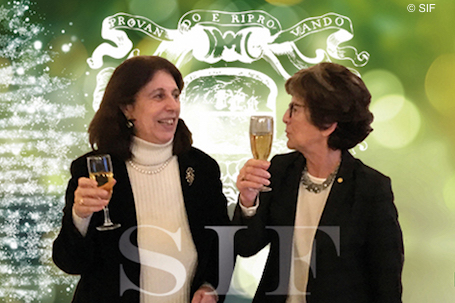
Angela Bracco and Luisa Cifarelli
Here comes my last editorial, as President, on SIF Prima Pagina, the electronic newsletter that supports Il Nuovo Saggiatore as from 2014. Bulletin of the Italian Physical Society, founded in 1985 on an idea by Pio Picchi, renewed in its editorial format since 2008, Il Nuovo Saggiatore – whose last 2019 issue has just been published – represents today not only the voice of SIF in Italy and abroad but also a well-known and appreciated magazine for the dissemination of scientific culture.
This year, during the Congress, the elections for the societal offices of the SIF were held, the outcome of which shows that overall almost 44% of eligible Members voted. A higher percentage would have been preferable but it was still a percentage comparable with or even higher than those usually obtained in other Societies, for example the IOP (Institute of Physics) or the APS (American Physical Society), in similar electoral consultations.
The Council renews itself with two new Councillors, Antigone Marino and Bernardo Spagnolo, and a new President, to whom I am very happy to pass the baton after so many years of presidency. It is the eminent colleague and friend, Angela Bracco, from the University of Milan. Indeed, I am really happy to do this with a female SIF President, the second case in 122 years of the Society's history!
The SIF closes 2019 with a budget that does not raise particular concerns despite the current changing scenario of scientific publishing that does not seem to want to favor small publishing houses. But the SIF has excellent relations and international partnership contracts, in particular with Springer Nature, which for now "secured” it". Another security factor derives from the efficiency and effectiveness of its editorial offices, from the quality of its own journals, especially La Rivista del Nuovo Cimento, which exceeded this year seven points of impact factor, and from the value of its volumes. After the publication and presentation at the Library of the Italian Senate of the volume "I Fisici Senatori 1848-1943", the upcoming publications are: "Scientific Papers of Ettore Majorana – A new expanded edition" and "Laura Bassi - The world's first woman professor in natural philosophy – An iconic physicist in Enlightenment Italy" (the latter both co-produced by SIF and Springer Nature).
Of course, the good economic performance of the SIF is also and above all due to its virtuous personnel and careful management of resources. All this allows it to hold in Varenna its famous courses of the International School of Physics "Enrico Fermi" and of the EPS-SIF International School on Energy, to organize every year its National Congress, to establish its numerous and coveted awards for young and less young people, to carry out his multiple sponsorships of events, scholarships, etc.
Finally, since I don’t want to retrace all the many actions taken by the SIF during the years of my presidency, also internationally thanks to its lively collaboration with other Societies, especially the EPS (European Physical Society) and the APS (American Physical Society), I leave it to you to do the repertoire. I just like to remember some of them, starting from the report "The impact of physics on the Italian economy", commissioned by the SIF to Deloitte in 2014, in collaboration with the major Italian research institutions; passing through the battle for the Association of professional physicists and then for the Order of professional chemists and physicists (which was carried out after many "fibrillations"), for which the SIF continues to be activate through various institutions, in particular ConPER (Consulta dei Presidenti degli Enti di Ricerca); and ending with the very recent and immediate signing by the SIF of the open letter in support of Education and Research as priority areas for Europe. The letter has achieved an unexpected success and allowed to modify the portfolio’s title of the new European Commissioner M. Gabriel from "Innovation and Youth" to "Education, Research, Culture, Innovation and Youth".
Having reached this year the end of my mandate, I sincerely thank the SIF and its staff. I thank all the Councillors with whom I have had the honour of collaborating and express my warmest wishes to the President and to the newly elected Councillors.
To all SIF Members, who with their support and trust have granted me in all these years a fabulous and unforgettable opportunity, my warmest thanks.
To them and to all our readers, Happy 2020!
Luisa Cifarelli
SIF President
This editorial is a republication from the Editorial of SIF Pagina, the newsletter of the Italian Physical Society, dated 20 December 2019
This post has not been tagged.
Permalink
|
|
|
Posted By admin,
Tuesday 11 February 2020
Updated: Thursday 13 February 2020
|
With the installation of two more detection units at the French site of KM3NeT, the first phase of building the ORCA detector of the KM3NeT neutrino telescope is now complete. Since 27 January 2020, the detector is taking data with six detection units. The first candidate neutrino events are already seen.
During a sea campaign in January, two new detection units were connected to the seafloor network at the KM3NeT/ORCA deep sea site, 40 km offshore from Toulon, France (Figure 1). The detection units were successfully positioned twenty metres apart to within a metre of their target position 2.5 km below the sea surface. This highlights the skills of the staff on board the deployment ship, the precision of the custom acoustic positioning system and the maturity of the deployment method based on an innovative launching vehicle. Using a robot, remotely operated from a second ship, the deployed units were connected to the seafloor network of the ORCA site. After a visual inspection of the detection units by the robot, the power was switched on and data taking with ORCA6 started immediately.
The ORCA6 detector
The ORCA detector has now six detection units - hence ORCA6. These are six vertical lines each with 18 optical modules (Figure 2), high-pressure resistant glass spheres housing 31 3-inch diameter photo-multiplier tubes to record the faint Cherenkov light generated by charged particles in the sea water. Each photo-multiplier records the intensity of the light flash, i.e. the number or photons, and - with a nanosecond precision - when it arrives. A compass, tilt meter and acoustic receiver record the position of the module in the sea water within a few centimetres. With these measurements the path the charged particle took through the detector is precisely reconstructed.
Searching for neutrino events
Physicists are on shift around the clock, 7 days a week, to remotely operate the deep sea detector. The recorded data is stored in the computer centres of the KM3NeT Collaboration for further analysis. The first step is to reconstruct from the recorded light flashes the path of charged particles through the ORCA6 detector. Most of them are muon particles generated in the Earth's atmosphere and travel downwards through the detector (Figure 3). A few others travel upwards (Figures 4 and 5); this is an indication that they are neutrinos that have passed through the Earth and interacted in the vicinity of the detector.
Important milestone for ORCA
Operating six detection units is an important milestone for KM3NeT as it marks the completion of the so-called 'Phase 1' of ORCA. In the next phase of KM3NeT/ORCA, the detector will be extended to 115 detection units. With the full ORCA detector, the KM3NeT researchers aim to determine the neutrino mass ordering using atmospheric neutrinos.

Figure 1: Deployment of a detection unit at the ORCA site of KM3NeT. © KM3NeT

Figure 2: The KM3NeT optical module. © KM3NeT

Figure 3: Example of a reconstructed down-going atmospheric muon observed by ORCA6.
Optical modules hit by the Cherenkov light are shown enlarged. © KM3NeT

Figure 4: Example of a reconstructed candidate neutrino event observed in ORCA6.
Optical modules hit by the Cherenkov light are shown enlarged. © KM3NeT

Figure 5: A so-called z-t plot of a candidate neutrino event measured in ORCA6.
The six plots correspond to the detection units. On the y-axis the height in the detector and the on the x-axis the time of arrival of the light. Each point represents a detected photon. The red points are the hits that triggered the event and the red line is the projection of the fitted Cherenkov light cone. © KM3NeT
author: Els de Wolf, Nikhef, Amsterdam
Tags:
KM3NeT
multimessenger astronomy
neutrino
ORCA
Permalink
|
|
|
Posted By admin,
Tuesday 11 February 2020
Updated: Thursday 13 February 2020
|
The European Group for Atomic Systems (EGAS) will hold its 52th annual conference from July 6 to 10, 2020, in Zagreb, Croatia. Several highly distinguished plenary and invited speakers will present their research in Zagreb, including Ignacio Cirac, Jean Dalibard, Frédéric Merkt, Christiane Morais Smith, Ruth Signorell and Jun Ye, among others. More than two hundred scientist from across Europe are expected for this 52th EGAS conference.
Registration is now open, and detailed information can be found at https://www.egas52.org
The EGAS group is part of the Atomic, Molecular and Optical Physics Division of the EPS with the aim to promote studies in atomic, molecular, and optical physics and related topics. Information on the EGAS activities and on previous EGAS conferences is found at http://www.eps-egas.org
author: Rosario Gonzalez-Ferez, chair of the EPS EGAS board
Tags:
conferences
EPS EGAS
European Group on Atomic Systems
Permalink
|
|
|
Posted By admin,
Monday 10 February 2020
|
The ultimate victory of the Conservative party left no doubt that the UK would leave European Union. The scientific community (and others) has serious concerns about the impact on research and development of the EU budget this process will bring along.
The UK elections that took place last December brought no good news for all the individuals that were hopeful the UK would remain in the EU. With this outcome, it has been decided that the UK will leave the EU at the end of January 2020 and it will enter in a transition period ending in December 2020. During this one-year time-frame, the UK prime minister, Boris Johnson, and the EC President, Ursula von der Leyen, will have to negotiate a new trade relationship. The agreement struck between the EU and UK says that this transition period can be extended by up to two years if both sides agree, but a decision must be made before July 2020[1]. Many commentators have warned that the negotiations on the future relationship between the EU and the UK are going to be difficult, especially taking into account the time-frame provided in the Withdrawal Agreement.
Brexit footprint on the European R&D
The earlier optimism that hoped that the EU would find its stability once the Brexit process was complete is being challenged. Now, it seems that the period that will follow will bring more uncertainties. Both sides, the UK and EU should strike a trade deal by the end of 2020, which most say it is an almost impossibly brief time to design a full agreement. According to Andre Geim, Nobel Prize winning physicist, Regius professor and Royal Society research professor at Manchester University, in order to prevent a disaster in the research area, the UK has shifted their populist approach and has adopted pragmatism for the post-Brexit negotiations. He also stated that he sees a slight hope in this regard, as the UK has already restored the student visa programme, cancelling the changes introduced by ex-prime minister Theresa May, which severely harmed universities and economy. “If things continue this way, it should be possible for the UK to stay in the European Research Council (ERC) and Marie Curie frameworks, two of the most valuable EU programmes and important for UK universities” [2] – Geim pointed out. It is worth noting that UK is the biggest beneficiary of the ERC programme.
Participation in the Horizon Europe Programme
The UK government and the European Commission have both expressed interest in future cooperation on research and innovation. But such an agreement, which would include association to the EU’s research programmes, would be “unprecedented” due to the fact that every country that is associated to the ongoing Horizon 2020 has a pre-existing broader trade arrangement in place with the EU.[3]
Furthermore, Mariya Gabriel, commissioner for innovation, research, culture, education and youth, said that the basic principles for UK entry into the EU’s next big research programme would be the same as for other non-EU countries and that there is no place for “cherry picking”.[4] The UK “will be considered as a third country” and the basic principles of its Horizon Europe membership would be the same as for Canada, Japan, Singapore, New Zealand and other rich non-EU countries with which the Commission has raised the possibility of full partnership.
Nonetheless, under the terms of the Brexit transition, the UK remains eligible to participate fully in the Horizon 2020 programme, which finishes at the end of the year but there is no agreement as of yet for the next EU research programme.
Tags:
Brexit
Europe
Permalink
|
|
|
Posted By admin,
Monday 10 February 2020
|
During the EPS 2019 conference held in Ghent last summer, Rob Appleby, Chris Edmonds and Robyn Watson were awarded the Outreach Prize of the EPS High Energy Physics Division " for the Tactile Collider Project that brings particle physics to blind and visually impaired schoolchildren through touch and sound."
On 14 and 15 September 2019, Tactile Collider was installed at the CERN Open Days. These were attended by 6,000 visitors who had the opportunity to discover the project and it’s unique way of delivering science.
What is Tactile Collider?
The installation consists of a series of metal tubes of around 2 metres in length which are assembled in a ring representing the CERN Large Hadron Collider, a circular particle accelerator of almost 27 km in circumference. Placed within this tube network are tactile representations of the (RF) cavities and dipoles which are made from different materials to encourage participants to touch and explore the accelerator model. Other 3D-printed elements show magnets and the movements of particles inside the accelerator. Participants are also able to touch tactile diagrams to bring to life the Higgs boson.
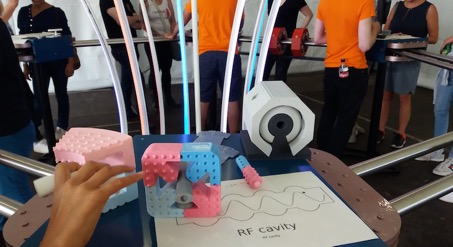
Tactile Collider invites participants to touch the elements to grasp the principles of a particle accelerator
A clash outside the collider
In 2014, Manchester welcomed "Collider", a temporary exhibition looking at the discovery of the Higgs boson. When two blind visitors asked if there was a way for them to access the exhibit the idea for Tactile Collider was born.
Dr Rob Appleby (University of Manchester) worked alongside Dr Chris Edmonds (University of Liverpool) to look at ways of delivering particle accelerator physics to a visually impaired audience (VI). Using an online forum they asked for people with visual impairments to give advice on what their expectations were in similar situations and what could be suggested to improve facilities in exhibitions. Robyn Watson, a teacher of the visually impaired replied and she became the link between the scientists and the children.
It took 6 months to develop the Tactile Collider installation. In 2017, a prototype was created at Cockcroft Institute and Robyn and her students worked alongside Rob and Chris to finalise the tactile objects and delivery of the project. Later in the same year, a "soft launch" was organised as test event at St Vincent’s School in Liverpool. Robyn went there to observe the participants and she gave feedback again.
In 2018, the Tactile Collider team organised several events throughout the UK: science museums, schools, music festivals. Tactile Collider was taken on tour with the hope of being accessed by as many students as possible. It was intended for children with VI but also worked for a non-VI audience to raise awareness of visual impairment and to make science accessible to all. The project evolved every time it was presented and encountered huge success everywhere.
Parents of the children who attended have explained their delight in feeling that their children can access the same information as other pupils. Tactile Collider is designed to be accessible for children with VI, however this also makes it an exciting project for all students and adults who are interested in discovering science. It simplifies complicated physics concepts and breaks them into smaller, digestible parts.
The project also brings together scientists and children with VI, this is a key aspect of the programme and allows students to connect with someone working with science everyday. For the children with VI having subject specialists like physicists explaining the science gives them the opportunity to explore ideas for further study and employment that they may otherwise have felt wasn’t possible.
Robyn, in her work as teacher of the visually impaired, works with teachers to make their lessons accessible to children. She teaches them that there is value in diversity and inclusion.
Before receiving the 2019 EPS HEP Outreach Award, the Tactile Collider team won the "2018 University of Manchester People’s Vote for the Faculty of Science and Engineering’s Better World Showcase" and was "Highly Commended in the Making a Difference Awards for Social Responsibility 2018 for Outstanding Contribution to Equality, Diversity and Inclusion". They have since won the "RNIB 2019 Innovator of the Year Award" in the UK.
The future of the Tactile Collider
Tactile Collider would like to inspire a generation of children with visual impairements as well as members of the general public. To allow them to engage with high level learning in places like schools, science festivals and museums.
The next step is to develop new projects, organise events in the UK and beyond. Rob, Chris and Robyn are currently planning a workshop to train educators on how to deliver the science behind Tactile Collider and on how to include learners with VI in their lessons and workshops.
So stay tuned for more news about the Tactile Collider team. And let yourself be inspired by their enthusiasm to spread science to everyone!
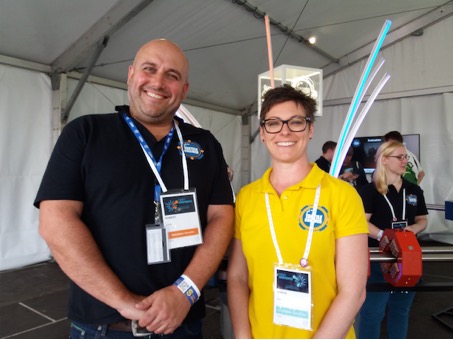
Rob Appleby and Robyn Watson participated in the CERN Open Days
and welcomed almost 6,000 visitors to explore Tactile Collider
The Tactile Collider team
- Rob Appleby: Physicist at the University of Manchester and the Cockcroft Institute.
- Robyn Watson: Teacher for visually impaired children at Bolton Sensory Support Service.
- Chris Edmonds: Physicist at the University of Liverpool and the Cockcroft Institute.
 You can listen to the article here: https://tinyurl.com/tmwvmuo You can listen to the article here: https://tinyurl.com/tmwvmuo
(Robyn Watson reading)
author: Gina Gunaratnam
Tags:
EPS HEP
eps hepp prizes
outreach
Tactile Collider
Permalink
|
|
|
Posted By admin,
Monday 10 February 2020
Updated: Monday 10 February 2020
|
The goal of a good communicator must be to seek new ways to raise interest and curiosity, to involve the observers as much as possible and to make them an active part of what is being done. With this belief, the Young Minds section of Naples PONYS (Physics and Optics Naples Young Students) has created a Physics-themed escape room, presented for the first time at the 33rd edition of the "Futuro Remoto" scientific festival, held in Naples from 21 to 24 November 2019.
The project was inspired by the classic “escape room”, from which players have to get out in a limited time by solving riddles. The PONYS Physics Escape Room uses exactly the same structure with one fundamental difference: all the clues hidden inside the room direct the players to carry out simple physics experiments.
Once in the Physics escape room, players enter Professor Ostinato's lab, where they are challenged to save the world from a deadly nuclear explosion, which can be defused only from the professor's computer. Players must then recover the password and unlock the computer by solving the clues the professor scattered all around his lab. Therefore, the players become active players of the scientific experience, carrying out the experiments by themselves, without a communicator to bridge the gap between them and the scientific phenomenon. This type of approach is much more stimulating for the players, who, driven by the desire to win and leave the room, try to carry out the experiment suggested by the clue in every possible way. The players have to sharpen their wits and keep a level of concentration greater than what they would have if they were just spectators.
Once the game is over the communicators come into play: their role is to guide the players through a scientifically sound interpretation of the experiments carried out to exit the escape room. However, the role of the communicator is not limited to this: during the game the participants may need some help to proceed. The communicators must overcome this need and they must be ready to interact with the players by guiding them with witty suggestions that can lead them to the correct answer.
The Physics Escape Room has encountered a huge favour among the public, being one of the most successful attractions of the science festival, demonstrating that an active learning approach is a key factor in outreach activities. Given the popularity of the activity, the Physics Escape Room will be repeated soon during other events.

Ponys mediators at the entrance of the Physics Escape Room
© Norma Gaetani d’Aragona di Cirigliano
author: Giorgia Tortora
This post has not been tagged.
Permalink
|
|
|
Posted By admin,
Monday 10 February 2020
Updated: Monday 10 February 2020
|
Last year Hungary solemnly commemorated, under the aegis of UNESCO, the centenary of the passing away of Roland Eötvös (1848-1919), the founding father of Geophysics. As is generally known, Eötvös developed the ‘torsion balance’ carrying his name, an instrument sufficiently sensitive to charter the variation of gravitation in the field. Since gravitation is a matter of masses, the ‘torsion balance’ is able, so to speak, to look in the underground. In 1916, its first important achievement, namely the confirmation of the existence of oil fields at Egbell (now Gbely, Slovakia), showed its fiability.

Fig.1 Roland Eötvös (1848-1919) by Gyula Éder (1941; oil on canvas).
Courtesy: Roland Eötvös University (ELTE), Budapest.
In a next issue of the series ‘Tributes’, in Europhysics News, details of theory and practice of the instrument will be discussed. Accidently, during the preparation of the ‘Tribute to Roland Eötvös’ crucial new souvenirs of Eötvös showed up in the Archives of the Ruprecht-Karls-University, at Heidelberg. Indeed it was at Heidelberg’s University that Eötvös studied Physics as his ‘major’—under no one less than Gustav Kirchhoff (1824-1887)—with Chemistry and Mathematics as ‘minors’. In 1870, he also passed the PhD at Heidelberg, ‘summa cum laude’, that is, with the highest possible honours. Importantly, the formalities at the time were not our’s. Passing the PhD, mostly, occurred without a dissertation. It consisted of an oral examination in German of 2-3 hours before the assembled Professors of the Heidelberg Faculty of Philosophy.
For the EPS-community it is interesting that the PhD-files concerning Eötvös still exist: the Archives of the University of Heidelberg, the oldest of all of Germany, is able to document almost all doctorates awarded in its long past. In the case of Eötvös, something fully unknown showed up: a handwritten curriculum vitae by Eötvös himself, and in still compulsory Latin. As we may imagine, this find will enable to further detail Eötvös’ already exciting biography. It was announced last January 23rd before the Aula of the Ruprecht-Karls-University, Heidelberg (Fig.2).

Fig.2 Presentation of the Eötvös files as (re)discovered in the Archives of the
Ruprecht-Karls University, Heidelberg, on January 23rd, 2020.
In the middle: Matthias Weidemüller, Pro-Rector of the University and physicist.
On the right: Ingo Runde, Director of the Archives.
On the left: Henk Kubbinga (EPS-History of Physics Group).
Picture: Oliver Fink (Press Departement, Heidelberg).
author: Henk Kubbinga
Tags:
Roland Eötvös
Permalink
|
|
|
Posted By admin,
Monday 27 January 2020
Updated: Monday 27 January 2020
|
author: J. L Hermans
On the 14th of January 1845, six young physicists from the ‘Gustav Magnus Kolloquium’ started the Physikalische Gesellschaft zu Berlin. Over the years, this developed into the largest physical society in the world. With over 55 000 members the DPG, the Deutsche Physikalische Gesellschaft now celebrates its 175th anniversary. The DPG will use this anniversary year to elucidate the importance of physics in and for society at large. The kick-off of the festivities took place on January 14th in the Magnus-Haus in Berlin, with many invited high-ranking officials. As a special highlight a unique historical photo (a ‘Daguerreotypie’) of the six founding fathers was unveiled at this occasion. The main celebration will be on June 6th, with several distinguished speakers like the President of the Deutsche Bundestag, Dr. Wolfgang Schäuble, and Nobel Laureate Klaus von Klitzing.
 website for the 175 years "German Physical Society" website for the 175 years "German Physical Society"
website of the German Physical Society
This post has not been tagged.
Permalink
|
|
|
|
 Print Page
 Blog Home
 All Blogs
 RSS
RSS