|
|
Posted By Administration,
Monday 1 April 2024
Updated: Tuesday 19 March 2024
|
We are delighted to announce that Prof. Anton Zeilinger has been
elected as an EPS Honorary Member at the EPS Council Meeting of 27th
March 2024. EPS honorary members are individuals that the EPS wishes to
recognise for their exceptional achievements in physics, whether in
research, industry and/or education. Prof. Zeilinger’s distinction is in
recognition of:
"Outstanding achievements in fundamental and
applied quantum physics, encompassing
quantum teleportation, novel entangled states and related applications
such as quantum communication, quantum cryptography, and quantum
computation; and for exceptional services to the European physics
community."
Prof. Zeilinger is an Emeritus Professor at the University of Vienna. In 2022 he was awarded the Nobel Prize in Physics alongside Alain Aspect and John Clauser.
Prof
Zeilinger has also worked tirelessly for the European Physics
Community. He is a former President of the Austrian Physical Society
and the Austian Academy of Sciences and he has been at the forefront of
the development of a European Quantum Technology Strategy.

Anton Zeilinger at the annual meeting of the Austrian Physical
Society in September 2022 in Leoben where he received the honorary
membership of the ÖPG.
Tags:
awards
EPS Honorary Members
Nobel Prize
Permalink
|
|
|
Posted By Administration,
Monday 19 February 2024
Updated: Monday 19 February 2024
|

Author: Luc Bergé
After Paris in 2022, Berlin will host the second Forum of the European Physical Society (EPS) on March 25 and 26, 2024 at the Henry Ford Building of Freie Universität Berlin.
What is the EPS Forum?
The Forum is an exceptional meeting prepared by all EPS bodies, Member Societies, Divisions and Groups, and Associate Members.
Opened by European Commissioner Iliana Ivanova, the first day (March 25) "Physics meets Industry" will propose various tutorial talks and many round tables on the industrial developments in different fields of physics.
The second day (March 26), starting with a Nobel session, will address the latest scientific advances in the same physics topics. Anne L'Huillier, Klaus von Klitzing, Stefan Hell will be there to deliver plenary talks.
What are the topics of the EPS Forum?
The scientific topics of the Forum will cover a wide range of fields in physics:
- Atomic, molecular and optical physics for quantum technologies
- Applications of nuclear and particle physics to society
- Condensed matter and applications to industry
- Energy management, pollution and climate
- Artificial intelligence, brain inspired processing systems and applications
- Photonics
Who is the EPS Forum for?
Early-career and senior researchers are invited to participate in the Forum. Young researchers (master, PhD students and postdocs) are particularly invited to come to Berlin, discover the most recent employment opportunities in the physics-based industry sector and exchange with world-renowned researchers.
The EPS will support the travel and lodging expenses of 100 physics students.
Check the programme at https://epsforum.org/programme/
 There is still time to register until March 3 at https://www.epsforum.org/register/ There is still time to register until March 3 at https://www.epsforum.org/register/
Tags:
conferences
EPS Forum
Freie Universität Berlin
FUB
Nobel Prize
Permalink
|
|
|
Posted By Administration,
Monday 27 June 2022
Updated: Monday 27 June 2022
|
Author: Luc Bergé
On June 2 and 3, the EPS held its first Forum at the International
Conference Center of Sorbonne University (SU) in Paris, France. Prepared
for more than a year with our Member Societies and our Divisions and
Groups, the EPS Forum welcomed 487 participants among whom 184 students
coming from 30 different countries.
The format of the EPS Forum (www.epsforum.org)
included a series of conferences, round tables and workshops on the
following topics: Energy and sustainability, accelerators, high-energy
particle physics, nuclear physics, quantum technologies and photonics,
machine learning and artificial intelligence, biophysics, technological
sequencing of biomolecules and human health, condensed matter physics:
from quantum materials to additive manufacturing.
The
objective of the EPS Forum was to showcase the latest developments in
the above fields of physics, both from their potential links with the
industry and current opportunities of employment for the young
physicists and from the most recent achievements in fundamental science.
The EPS Forum, therefore, dedicated two days for each of these goals.
Thursday June 2nd was devoted to “physics meeting industry”. This meeting fostered direct
exchanges between physicists - with a majority of master, PhD students,
postdocs and early-career researchers - and stakeholders and managers
of physics-based industrial companies. This first day of the Forum was
opened by a plenary conference given by Mariya Gabriel, European
Commissioner for Innovation, Research, Culture, Education and Youth
about filling the gap between science and innovation. More than 60 young
researchers were able to present the results of their research during a
long poster session.
Friday June 3rd
hosted a scientific colloquium highlighting the latest achievements in
physics by the most outstanding physicists in Europe and beyond. The
morning session welcomed three laureates of the Physics Nobel prize,
namely, Prof. Barry Barish from Caltech, USA, who talked about
gravitational waves and the LIGO collaboration, Prof. Serge Haroche
from École Normale Supérieure & Collège de France in Paris, who
surveyed the history of quantum physics to its latest developments in
applied research, and Prof. Michael Kosterlitz from Brown University,
USA, who addressed theoretical and numerical issues on the solving of
nonlinear partial differential equations. All along this second day,
several round tables dealt with various societal topics, such as physics
training and the gap between schools and universities, strengthening
the EPS Member Societies through structures for mutual support, or the
European Research Council (ERC) and Widening Participation of Eastern
and Southern States, for which Andrzej Jajszczyk, ERC Vice-President for
physics, was invited to give a talk.
In
parallel to these two days, three hands-on sessions dedicated to
quantum computing and a masterclass on scientific writing trained our
students on these different topics, while the patio of the Conference
Center housed 25 stands that experienced fruitful exchanges with
students looking for job opportunities.
Also,
the EPS Young Minds held their annual Leadership Meeting, a very
successful event full of participants from all over the world. 25
representatives from the International Association of Physics Students
(IAPS) and 25 others from the 5 Universities of the SU 4Eu+ Alliance
were moreover invited by the EPS to enjoy the different conferences and
sessions of the Forum. Some of them helped our secretariat in the
logistics of the event and we thank very much these student helpers.
The
Forum was financially supported by several Member Societies of the EPS
and by many sponsors for which a wall of logos was especially prepared:
More than 70 research organisations, large industrial groups, medium and
small-sized companies, leading start-ups and learned societies
positively responded to our invitation to contribute to this event. In
particular, several EPS Associate Members were directly involved in its
organisation. The programme committee included 75 members from all the
EPS constitutive bodies who met monthly to prepare the Forum and the EPS
Secretariat managed the conference in highly professional manner.
In
summary this first edition of the EPS Forum clearly demonstrated the
possibility to make all the EPS components regularly work over a year in
order to achieve all together a place and a while to promote the young
generation of European physicists, to bridge the gap between academic
research and industry, and to still advertise the latest developments in
fundamental physics at the highest level.
The
Forum allowed all our community to meet and share mutual interests in a
pleasant and relaxed atmosphere. Installing this event over time is the
next challenge for the EPS.

A few photos extracted from the Forum, including Serge Haroche’s
plenary talk in the auditorium, a hands-on session,
the lunch break at
the patio of the Conference Center and the Young Minds Leadership
Meeting.
Tags:
conferences
EPS Associate Members
EPS Emmy Noether Distinction
EPS Forum
EPS Member Societies
Nobel Prize
Paris
Sorbonne University
workshops
Permalink
|
|
|
Posted By Administration,
Tuesday 16 November 2021
|

The Ampère house and museum in Poleymieux near Lyon, France. Photo: Christian Barberon/Wikimedia Commons
Author: Alfonso San Miguel
Wednesday, October 6 2021, the Ampère Museum was inaugurated as an
EPS Historic Site. This is the fifth site in France and it is
dedicated to André-Marie Ampère.
The Ampère family home, where
André-Marie spent his childhood and studied brilliantly with his father,
had an exceptional destiny. The state of Poleymieux-au-Mont-d'Or
(Rhône) where it is located, about fifteen kilometers from Lyon, was
sequestered for the benefit of the Nation in 1793, when the French
Revolution condemned the future scientist's father to death. Restored to
the family two years later, it fell to Ampère in 1812, after the death
of his mother. He relinquished it ten years later when he settled
permanently in Paris.
André-Marie Ampère spent a very large part
of his childhood and youth in this house, soon after his birth in 1775
until he was 29 years old. Without attending school, he read Diderot’s
Encyclopedia and learned to scrutinize Nature and to understand the
mathematics, physics and chemistry of his time. It was during this
period that emerged his first ideas about the relationship between
electricity and magnetism. Few years later, in 1820 he established the
first mathematical relationships between these two physical phenomena.
By giving the name of Ampère to the international unit of electrical
current, the whole world saluted his fundamental discoveries, which gave
rise to electrodynamics.
It took a century for the Poleymieux
estate to regain the memory of its prestigious former owner. It was on
the advice of Paul Janet, a member of the French Academy of Sciences,
that two wealthy American industrialists, Hernand and Sosthène Behn,
bought the estate in 1928. They donated the estate to the French Society
of Electricians (SEE), which entrusted it to the Society of the Friends
of André-Marie Ampère (SAAMA), an association created to manage and
develop a Museum of Electricity and to perpetuate the memory of the
illustrious Lyon native. The Museum of Electricity was inaugurated on
1st July 1931.
The EPS Historic Site ceremony, which was part of
the "Ampère 200 ans" (Ampère 200 years) programme of commemorations for
the bicentenary of André-Marie Ampère's discoveries in electrodynamics,
was sponsored by Serge Haroche, 2012 Nobel Prize in Physics. In the
morning, Serge Haroche gave a lecture at the University of Sciences of
Lyon to more than 400 participants on the history of light. He
highlighted the importance of André-Marie Ampère's discoveries in the
unification of electricity, magnetism and optics. At the end of the day,
the ceremony continued at the Ampère Museum where the commemorative
plaque was unveiled by Serge Haroche and Luc Bergé in front of a hundred
people, representatives of the academic world of Lyon, the electricity
industry and learned societies. The ceremony was conducted together by
François Gerin, president of the SEE, who also read a message from
Gérard Mourou, 2018 Nobel Prize in Physics and sponsor of “Ampère 200
ans”, and by the President of the Society of the Friends of André-Marie
Ampère, Alfonso San Miguel, who nominated the site.

FLTR: Guy Wormser (SFP), François Gerin (SEE), Serge
Haroche, Luc Bergé (EPS), Gabriel Fioni (representative of the French
Ministry of Higher Education and Research),
Corinne Cardona (major of
Poleymieux) and Alfonso San Miguel (SAAMA and SFP) - Photo: Alfonso San Miguel
Tags:
Ampère
award
electrodynamics
EPS Historic Site
France
Nobel Prize
Serge Haroche
Permalink
|
|
|
Posted By Administration,
Tuesday 27 January 2015
Updated: Friday 17 May 2024
|
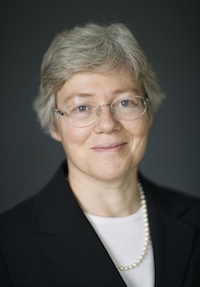
Professor Anne L’Huillier
Author: Lucia Di Ciaccio
It is a
great pleasure to announce that the Autumn 2014 EPS Emmy Noether
Distinction for Women in Physics goes to Prof. Anne L’Huillier, Faculty
of Engineering, LTH in Lund, Sweden.
Prof. L'Huillier is one of
the key leaders in a field at the interface of atomic and molecular
physics and advanced optics, nonlinear optics and laser physics:
high-order harmonic generation [HHG] in gaseous media exposed to intense
laser fields and its applications, in particular to attosecond science.
After
a thesis in experimental atomic physics at CEA Saclay, she got a
permanent position as researcher at CEA in 1986 and, one year later,
participated in an experiment where high harmonics were observed for the
first time. She moved to Sweden in 1994, was awarded a lecturer
position in 1995 and a professorship in 1997. Enjoying the university
environment, which allowed her to combine basic research and teaching,
she focused her experimental and theoretical work on the understanding
and the optimization of the HHG process, and on its applications to
ultra-fast x-ray science, with the ambitious goal to capture and
ultimately control the motion of electrons in atoms and molecules on the
attosecond timescale.
She is a member of the Swedish Academy of Sciences since 2004.
We
present a short interview between Anne L’Huillier [ALH] and Lucia Di
Ciaccio [LDC], chair of the Equal Opportunities Committee of the EPS, in
December 2014.
LDC: At what point in your education did you consider a career in physics?
ALH: Actually very early, as a child. But kept it discrete since I was not sure I could make it.
LDC: Do you believe that physics should positively discriminate in favour of women?
ALH:
This is a very difficult question for me since I benefitted myself
early in my career from a program “for women”. My answer is no, women
should not be positively discriminated. But one should avoid that good,
competent, women stop their career because of lack of funding, lack of
position, or simply lack of help/encouragement. We just can’t afford to
loose these women!
LDC: Do you have advice to girls who wish to start a career in physics?
ALH: This is a great job which is exciting and which also gives a lot of freedom. Go for it!
Tags:
Anne L'Huiller
attosecond physics
awards
calendar od physicists
EPS Emmy Noether Distinction
EPS Forum
inspiring physicists
Lund University
Nobel Prize
women in physics
women in science
Permalink
|
|
|
|
 Print Page
 Blog Home
 All Blogs
 RSS
RSS