|
|
Posted By Gina Gunaratnam,
Tuesday 10 October 2023
|

The Stachelschützenhaus in Basel, CH, that housed Daniel Bernoulli's Physics Cabinet - images: Gina Gunaratnam/EPS
Author: Gina Gunaratnam
On 22nd September, the former home of the Physics Cabinet of Daniel Bernoulli in Basel was inaugurated as an EPS Historic Site.
During
his time at the University of Basel, Daniel Bernoulli assembled a large
collection of demonstration experiments which he used for teaching and
public lectures. These were housed in the Stachelschützenhaus ("house of
the crossbow men"). The building is still used by the university and is
currently the centre for clinical virology.
The event started at
the University of Basel. Ernst Meyer, Friedrich-Karl Thielemann and
Philipp Treutlein, from the Department of Physics, welcomed the
participants.
Anne Pawsey, Secretary General of the European
Physical Society (EPS), introduced the Society and its Historic Sites
programme. She was followed by Martin Mattmüller, from the
Bernoulli-Euler Society, who described the life of Daniel Bernoulli in a
captivating presentation which included descriptions of the experiments
and quotations from attendees at his lectures.
Stephan Rosswog,
from the University of Hamburg and Stockholm University, showed how
Bernoulli’s theorem remains relevant in the extreme conditions of
neutron star mergers. Rossweg highlighted the importance of
multi-messenger astronomy to obtain sufficient complementary data, as
well as the enormous computational challenge of simulating these complex
processes across huge length and time scales.
After the lectures,
attendees walked to the nearby Stachelschützenhaus, where they were
introduced to the building's current use for research. The assembly
visited a part of the house before gathering in front of the plaque
describing Bernoulli's achievements and where he kept his physics
devices. Anne Pawsey and Philipp Treutlein officially distinguished the
house as the 6th EPS Historic Site in Switzerland.
More info

EPS Secretary General Anne Pawsey explaining the Historic Sites Programme

Martin Mattmüller from the Bernoulli-Euler Society

Stefan Rosswog from the University of Hamburg and Stockholm University

The participants in front of the Stachelschützenhaus

Anne Pawsey and Philipp Treutlein officially inaugurating the new Swiss EPS Historic Site

The plaque in front of the Stachelschützenhaus
Tags:
Bernoulli
Daniel Bernoulli
EPS Historic Sites
History of Physics
hydrodynamics
multi-messenger astronomy
neutrons stars mergers
SPS
Stockhlom University
Swiss Physical Society
University of Basel
University of Hamburg
Permalink
|
|
|
Posted By Gina Gunaratnam,
Tuesday 12 September 2023
Updated: Friday 15 September 2023
|
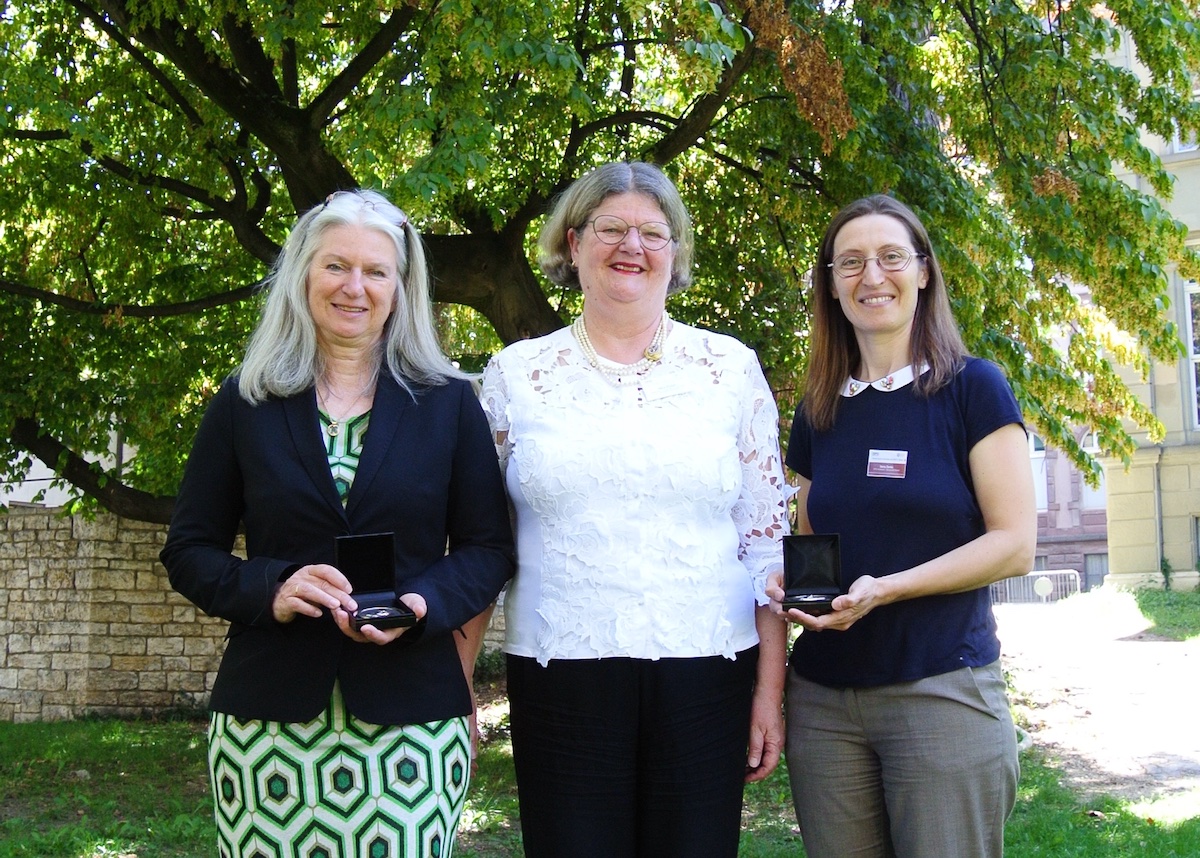
FLTR: Monika Ritsch-Marte, Petra Rudolf and Ilaria zardo - images: Gina Gunaratnam/EPS
Author: Gina Gunaratnam
The award ceremony of the joint meeting of the Swiss
Physical Society (SPS) and the Austrian Physical Society (ÖPG) took place in early September
at the University of Basel. Started with several awards of the SPS, the event continued with the prizes attributed
by the ÖPG and with the distinction of the
European Physical Society (EPS) dedicated to female physicists.
Prof.
Petra Rudolf, chair of the EPS Equal Opportunities Committee and former
president of the Society, handed over the EPS Emmy Noether Distinction
2022 to Prof. Monika Ritsch-Marte (full career) and to Prof. Ilaria Zardo (mid-career).
Monika
Ritsch-Marte, from the Institute of Biomedical Physics, Dept. of
Physiology & Medical Physics, the Medical University of Innsbruck,
Austria, was awarded " for exceptional contributions to
optical microscopy and manipulation methods and for the promotion of
women’s careers in physics. "
Ilaria Zardo, researcher at the Department of physics of the University of Basel, Switzerland, was awarded "for
her contributions in the methodology of characterizing nanoscale
materials and the consequent discovery of their new functional
properties. "
The ceremony was followed by an
interview of both EPS laureates by Prof. Rudolf and a group photo with
laureates of all the presented prizes in the beautiful botanical garden
of the Swiss university.
More info

Petra Rudolf presenting the EPS Emmy Noether Distinction to the SPS-ÖPG audience at the University of Basel

Group photo with all laureates of SPS, ÖPG and EPS prizes in the university's botanical garden
Tags:
distinction
Emmy Noether DIstinction
EPS EOC
EPS Equal Opportunities Committee
medical physics
nanomaterials
ÖPG
prize
SPS
University of Basel
Permalink
|
|
|
Posted By Administration,
Thursday 24 August 2023
|

image credit: University of Basel
22nd September 2023, University of Basel
Original publication: Website of the Swiss Physical Society
The
event is intended to honor Daniel Bernoulli (1700-1782, a member of the
world-renowned Bernoulli family of mathematicians and scientists that
had been based in Basel since 1623), especially for his role in the
development of physics in Switzerland, Europe, and the world, by making
the original site of his research in Basel, the Physics Cabinet in the
Stachelschützenhaus, an EPS Historic Site.
Daniel
Bernoulli (1700-1782) studied initially medicine in Basel, Heidelberg,
and Strasbourg, concluding with a thesis on respiration (containing
experimental and mathematical approaches). During his scientific life he
worked across many disciplines (with a focus on physics and its
mathematical foundations). In 1725 he was appointed to the St.
Petersburg Academy. In 1726 Leonhard Euler followed him to St.
Petersburg. Later on Bernoulli intended to return to Basel for a chair
in physics. But only after a vacancy in 1733 he was first successful in
obtaining a professorship in anatomy and botany, being offered finally a
professorship in physics in 1750. He then taught physics until 1776.
His most comprehensive work, the "Hydrodynamica"
of 1733/1738 achieved a fundamental advance in hydrodynamics and laid
the foundation for later progress, which included the well-known
"Bernoulli Principle", relating the speed of a fluid to its potential
energy. He published 74 papers and won a total of 10 Grand Paris Academy
Prizes for topics in astronomy, physics, and applications to nautical
problems. He was a pioneer in the development of mathematical physics by
using the powerful calculus of Leibniz in Newton’s theories.
Bernoulli's
predecessor as professor of physics at the University of Basel,
Benedict Staehelin (1695-1750), had started a collection of physics
devices and instruments that he had acquired for demonstration purposes.
These pieces were set up in the 'Physics Cabinet' (the south wing of
the "Stachelschützenhaus", built in 1729). Bernoulli added many more
apparatuses for his research and lectures on physics – among them the
experiment for the "Demonstration of the Hydrostatic Paradox" – which
demonstrates that the pressure in a liquid is independent of the shape
of the vessel and depends only on the height of the liquid column.
Bernoulli had thus significantly expanded the collection of Basel's
'Physics Cabinet'.
While the "Stachelschützenhaus" has later been
used by various other University Institutes (presently it hosts the
Clinical Virology), it was the place, where Daniel Bernoulli worked for a
quarter of a century, undertook research and gave his public
experimental physics lectures that enjoyed great popularity. For this reason the EPS has accepted our proposal to make the "Stachelschützenhaus" an EPS Historic Site. The inauguration will take place on 22nd September 2023.
Organisation: Philipp
Treutlein, Chair of the Physics Department, Ernst Meyer, President
Platform MAP/SCNAT, Friedrich-Karl Thielemann, Prof. emer.
Overview of the program
Tags:
Bernoulli
EPS Historic Site
events
History of Physics
ÖPG
SPS
University of Basel
Permalink
|
|
|
Posted By Administration,
Monday 20 June 2022
Updated: Monday 20 June 2022
|
Authors: French Physical Society, Swiss Physical Society
The Charpak-Ritz Prize 2022 awarded to Laura Baudis, for her leadership in international astro-particle physics
collaborations, outreach activities and seminal contributions to dark
matter research.

Laura Baudis is awarded with the 2022 Charpak Ritz Price jointly given by the French Physical Society and the Swiss Physical Society.
She has provided significant contributions to an increasingly burning
question in astrophysics and cosmology: What holds cosmological
structures together and controls the formation and evolution of
galaxies, including our own Milky Way? It remains an enigma that the
abundance of all known forms of matter is too low to explain the level
of gravitational interaction observed in galaxies, clusters of galaxies
and at the largest scales in the universe. This has triggered the
hypothesis of ‘dark matter’, which is undetectable by electromagnetic
interactions. The dark matter, which accounts for 85% of all matter in
the universe, could be made of new elementary particles, such as Weakly
Interacting Massive Particles (WIMPs). The search for WIMPs has been a
main pillar of Laura Baudis’ career.
For more than a decade,
experiments using two-phase (liquid and gas) xenon time projection
chambers (TPCs) have yielded the world’s best sensitivity in the direct
detection of WIMPs. Laura Baudis, who is a professor at University of
Zürich, has played a leading role in the development of large xenon
detectors with ultra-low backgrounds at their core. These are part of
the collaborative XENON programme, which started with XENON10, recently
operated XENON1T and currently acquires data with XENONnT. XENON1T
reached the lowest background ever observed in a dark matter detector
and observed the very rare two-neutrino double electron capture process
in xenon-124, an outstanding result in nuclear physics. XENON1T is
currently world-leading in providing the strongest constraints on WIMP
interactions over a broad mass range. To improve the statistical
sensitivity even further towards a possible detection of dark matter, an
upscaled experiment XENONnT was prepared and started in 2021. Apart
from her leading contributions to the TPCs, including the photosensor
arrays to observe the xenon scintillation light in the VUV region, Laura
Baudis has been assuming key roles in the collaboration: as
co-spokesperson, chair of the collaboration board and recently as chair
of the science strategy team. Towards the next generation effort DARWIN,
which she also co-founded, Laura Baudis has developed crucial
experimental setups and prototypes to selectively detect rare photon and
electron emission events in a large volume of liquid xenon as a
characteristic WIMP signature. It is also important to note that within
these larger multi-national research projects a significant part of
Laura Baudis’ work has been performed in collaboration with French
researchers at LPNHE in Paris and the SUBATECH laboratory in Nantes.
Next
to her complex multi-lateral scientific efforts, Laura Baudis has also
been actively involved in outreach activities, giving a TED talk and she
features in two documentary movies about Science and Scientists
(“Chasing Einstein”, “Eros und Atome” – in German).
Tags:
award
Charpak-Ritz Prize
SFP
SPS
Permalink
|
|
|
Posted By Administration,
Tuesday 11 January 2022
|
Author: Swiss Physical Society
The Swiss Physical Society (SPS) at its last General Assembly in September 2021 elected Johan Chang (University of Zürich, johan.chang@physik.uzh.ch) as its new President and Hans Peter Beck (University of Bern, Hans.Peter.Beck@cern.ch) as its new Vice-President. The Secretary Lukas Gallmann (ETH Zürich, gallmann@phys.ethz.ch) is continuing his office.
The full board composition can be found here: https://www.sps.ch/en/sps/executive-committee.
Tags:
EPS Member Societies
SPS
Swiss Physical Society
Permalink
|
|
|
Posted By Administration,
Thursday 23 September 2021
Updated: Friday 24 September 2021
|
Author: Antoine Pochelon
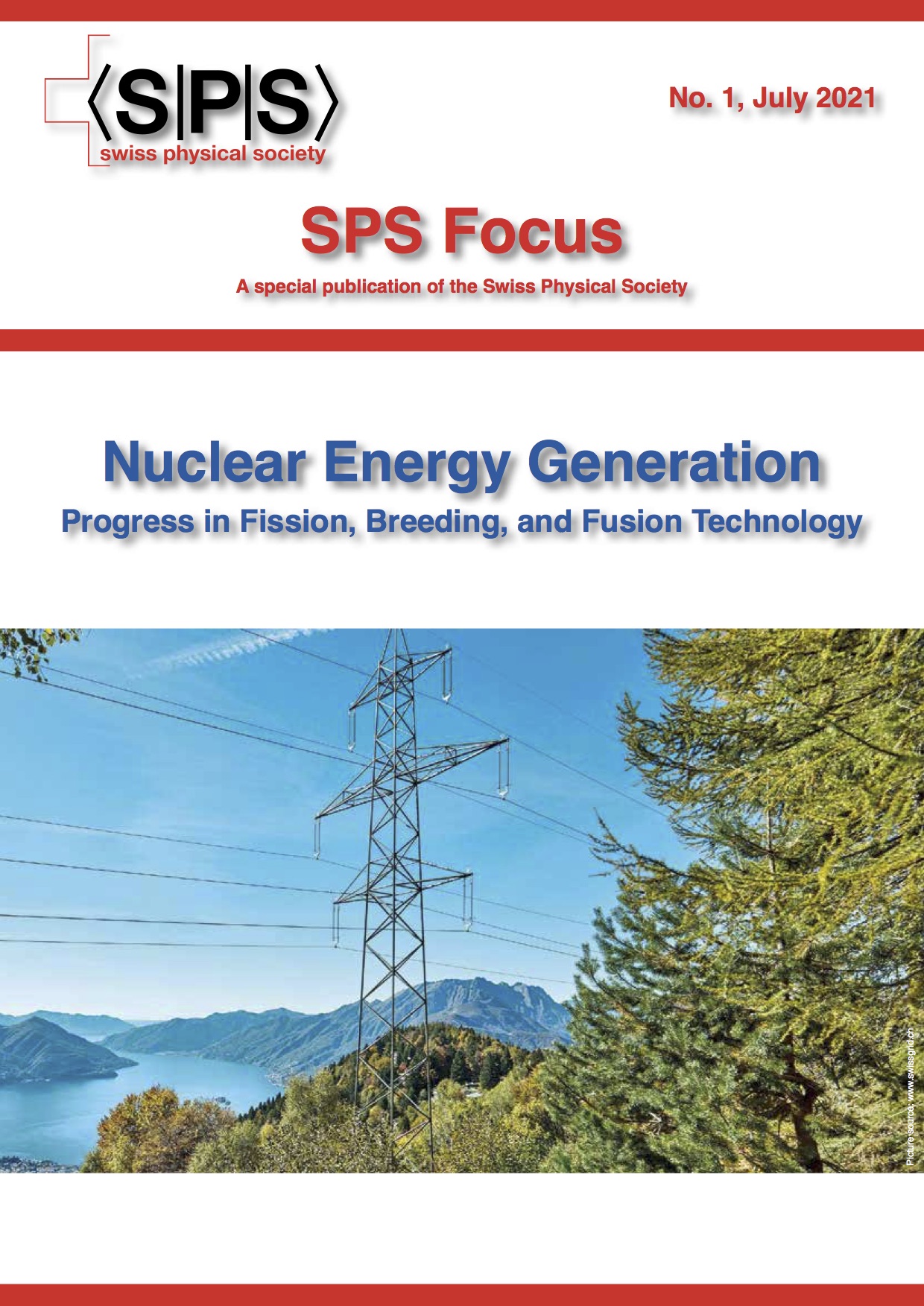
The first issue of a new publication series of the Swiss Physical
Society, SPS Focus, puts a focus on nuclear energy generation with
fission, breeding, and fusion based technologies.
Although some
countries have decided to completely stop generating electricity on the
basis of nuclear energy or to phase it out in the next coming years,
other nations are investing and increasing their portion of electricity
produced based on nuclear technologies. This is especially true with
regard to a hybrid mix of renewable and nuclear-generated energy, which
is seen as the optimal approach, especially in the USA and China, in
order to secure the growing demand for electrical energy from the point
of view of climate protection.
In SPS Focus No 1, three renowned experts present the state of the art and progress made in new generation uranium fission plants, the useof thorium instead of uranium as fission fuel which brings along the possibility to further “burn” existing radioactive waste, and finally the roadmap of nuclear fusion concepts.
The
print version has been sent to all 1200 SPS members, and to
international decision makers and institutions. First positive reactions
express the importance to reconsider nuclear technologies as a viable
energy source; especially when considering climate protection and a
net-zero emission of greenhouse gases in a low-carbon economy.
https://www.sps.ch/en/artikel/sps-focus/sps-focus-1
Tags:
energy
Focus
fusion
nuclear energy generation
publication
SPS
Swiss Physical Society
Permalink
|
|
|
Posted By Administration,
Wednesday 22 September 2021
Updated: Friday 24 September 2021
|
Author: Hans Peter Beck and Maurizio Musso
The 7th joint annual meeting of the Austrian Physical
Society (ÖPG [1]) and the Swiss Physical Society (SPS [2]), held at the
Technology Campus of the University of Innsbruck / Austria from August
30th to September 3rd, 2021, will go down in the
annals of the ÖPG and SPS as a great success. Over 600 participants
attended on site an extremely successful program [3], thanks to the very
constructive interaction of all board members of the SPS and the ÖPG in
preparation and final design of the joint conference, both with regard
to the plenary session and the topical sessions, and also with regard to
the entire award ceremony for prizes awarded by ÖPG and SPS, the
ceremony including the binational Charpak-Ritz Prize, jointly awarded by
SPS and the French Physical Society SFP [4].
This year lectures
in the plenary session spanned a wide range of physical and
physics-related aspects [3], i.e. from surfaces at the atomic scale to
materials, from quantum states to quantum optics and quantum
technologies, from particle colliders to free electron lasers, from
exoplanets to black holes, from physics and education to physics and
society, in particular also in connection with innovative products by
start-ups, with renewable energy and its repercussion on the climate,
and with quality of life in connection with medical applications of
physics-related technology.
Stimulated by the talks given in the
plenary session and in the topical sessions, and by the personal
exchange during the poster sessions, where some are accessible online
[3], it was indeed possible to show what the advantages of a personal
exchange are, being again achievable with the Covid certificate being
checked at the registration desk, and where it became self-evident that
physicists are predominately fully vaccinated. When new contacts are
made, when informal conversations spontaneously arise and where one can
build up mutual trust, the glue is formed to do further and better
research, allowing trying out new ideas in physics, which are the base
for the proposition and realization of new projects. It is this
inspiring vibe that motivates young members to stay long-term members of
the two societies and thus allows to actively shape the future
activities of the two societies, which get then also constructively
reflected by the associated activities of the EPS.

Winners of the prizes of the Austrian and of the Swiss Physical Society,
and the winner of the binational Charpak-Ritz Prize of the Swiss and of
the French Physical Society, together with the presidents of the
French, Swiss and Austrian Physical Societies. The prizes have been
bestowed during the 7th joint annual meeting of the Austrian and Swiss Physical Society in Innsbruck/Austria from 30th August to 3rd September 2021.
[1] Austrian Physical Society http://www.oepg.at/
[2] Swiss Physical Society https://www.sps.ch/en/home
[3] Program of the Joint Annual Meeting of ÖPG and SPS 2021 https://indico.cern.ch/event/1015032/timetable
[4] French Physical Society https://www.sfpnet.fr/
Previous report: https://www.eps.org/blogpost/751263/367164/Traditional-Joint-Annual-Meeting-of-two-physical-societies-2021
Tags:
Austrian Physical Society
conferences
Focus
ÖPG
publication
SPS
Swiss Physical Society
Permalink
|
|
|
Posted By Administration,
Thursday 12 August 2021
|
Author: Swiss Physical Society
The public Wilhelm Conrad Röntgen Symposium, which is
organised by the Swiss Physical Society (SPS), the Physikalische
Gesellschaft Zürich (PGZ) and the Swiss Academy of Sciences (SCNAT), is
planned as a face-to-face event on 18 September 2021 at ETH Zurich
(Hönggerberg). Five speakers will present Röntgen's biography,
mentioning his Zurich years at ETH and University, and his vibrant
legacy today regarding the exciting fields of new X-ray imaging
techniques, new coherent light sources and the revolution in X-ray
astronomy. (https://www.sps.ch/home)
The symposium will also be
available as an online video stream. The link to the live video stream
will be posted on the SPS webpage during week 37, from 13-18 September 2021.

Tags:
PGZ
Physikalische Gesellschaft Zürich
SCNAT
SPS
Swiss Academy of Sciences
Swiss Physical Society
Wilhelm Conrad Röntgen Symposium
X-ray
X-ray astronomy
Permalink
|
|
|
Posted By Administration,
Thursday 15 April 2021
Updated: Thursday 15 April 2021
|
Authors: French Physical Society & Swiss Physical Society
The French Physical Society and the Swiss Physical Society are proud to announce the 2021 winner of the Charpak-Ritz Prize:
Marie-Emmanuelle Couprie

image credit: Philippe Berteaud
Marie-Emmanuelle Couprie, researcher at the 2.75 GeV electron
synchrotron SOLEIL, located south of Paris, has received this award for her
outstanding contributions "in light sources using particle
accelerators to emit synchrotron radiation of high spectral purity and
high degrees of longitudinal and transverse coherence".
Dr.
Couprie is the head of the Magnetism and Insertion Device group at
SOLEIL and she is in charge of piloting the Free Electron Laser
activities. She is an expert of Free Electron Laser theory and
applications, she has an outstanding track record of referred
publications, and she is strongly involved in the development of
technologies with industries.
The Swiss Physical Society congratulates Marie-Emmanuelle Couprie warmly on this prestigious award. [More: spf-website, sps-website].
Marie-Emmanuelle
Couprie will receive the Charpak-Ritz medal on 1 September 2021 in the
award ceremony of the annual meeting, jointly organised by the Swiss and
Austrian physical societies, 31 August to 3 September 2021 in
Innsbruck, Austria, where she will also present her work in a plenary
talk to the participants of the conference.
Tags:
award
Charpak-Ritz prize
French Physical Society
prize
SFP
SPS
Swiss Physical Society
Permalink
|
|
|
Posted By Administration,
Sunday 21 March 2021
Updated: Monday 22 March 2021
|
Author: SPS
The Austrian and Swiss physical societies have a well-established
tradition in organising their annual conference every second year
jointly.
This will also be the case for the 2021 annual meeting,
when they will meet together at the University of Innsbruck, in the week
of 30 August - 3 September 2021.
An interesting and rich program
is thus guaranteed, with plenary talks in the morning and topical domain
sessions in the afternoon, with oral and poster contributions. Evening
lectures and a special session commemorating the 450th anniversary of
Johannes Kepler will round up the week.
The event is planned as an
in-person reunion where participants will be able to meet, exchange and
profit from each other, and there is good hope that this will be
possible again.
More information at the websites of the Austrian and Swiss societies.

Tags:
Austrian Physical Society
conferences
Kepler
ÖPG
SPS
Swiss Physical Society
Permalink
|
|
|
|
 Print Page
 Blog Home
 All Blogs
 RSS
RSS